Types of Chemical Bond
Chemical bonds form because atoms tend to become more stable by achieving a full outer electron shell — like the noble gases. There are three main types of chemical bond, and which type forms depends on the elements involved.
To work out which type of bond forms, you first need to identify whether each element is a metal or a non-metal.
Periodic table
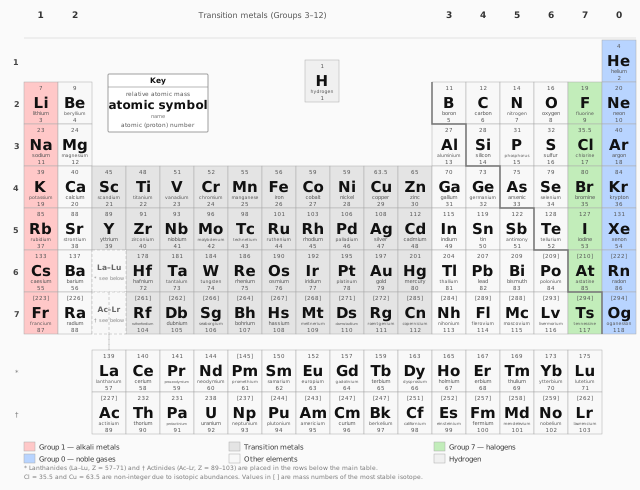
Need a clue? Use the staircase on the periodic table: metals are generally on the left and centre; non-metals are on the right. Hydrogen is the exception.
Use the periodic table above. For each element in the compounds below, click Metal or Non-metal to get immediate feedback.
| Elements involved | Type of bond |
|---|---|
| Metal + non-metal | Ionic |
| Non-metal + non-metal | Covalent |
| Metals only | Metallic |
Using the rules above, classify each substance as ionic, covalent, or metallic. Click a button for immediate feedback and an explanation.
The noble gases (Group 0) already have full outer shells — this is why they do not normally form chemical bonds and are so unreactive.
🧪 Exam-style questions
Magnesium oxide is made from a metal and a non-metal. What type of bonding holds it together? Tick (✓) one box.
Name the type of bonding in each of these substances:
(a) potassium chloride, KCl
(b) oxygen, O2
(c) copper, Cu
Show answer
- (a) KCl — ionic (metal + non-metal) 1 mark
- (b) O2 — covalent (non-metal + non-metal) 1 mark
- (c) Cu — metallic (a metal only) 1 mark
Ionic Bonding
Ionic bonding — the strong electrostatic attraction between oppositely charged ions. It occurs when a metal reacts with a non-metal. Electrons are transferred from the metal atom to the non-metal atom.
| Atom type | What happens | Ion formed | Example H |
|---|---|---|---|
| Metal | Loses electrons from its outer shell | Positive ion (cation) — fewer electrons than protons | Na → Na⁺ + e⁻ Mg → Mg²⁺ + 2e⁻ Al → Al³⁺ + 3e⁻ |
| Non-metal | Gains electrons into its outer shell | Negative ion (anion) — more electrons than protons | Cl2 + 2e⁻ → 2Cl⁻ O2 + 4e⁻ → 2O²⁻ |
The equations in the Example column are half equations — they show the electrons (e⁻) lost or gained as the ions form. Writing half equations is a Higher Tier skill; you'll meet them again in more detail in electrolysis (C4).
Metals are losers — they lose electrons and form positive ions.
Non-metals are gainers — they gain electrons and form negative ions.
The number of electrons lost or gained equals the charge on the ion. Atoms lose/gain enough electrons to achieve a full outer shell. For metals in Groups 1 and 2 and non-metals in Groups 6 and 7, the ions formed have the electronic structure of a noble gas (Group 0).
Anion → think A Negative ion. The start of the word spells out exactly what it is.
Ca+ion → the letter t looks like a + sign — a positive ion. Or if that doesn't stick: cats are pawsitive — and a cation is a positive ion.
The outer electron transfers from sodium to chlorine, forming Na⁺ and Cl⁻ — oppositely charged ions that attract each other electrostatically.
Example — Sodium Chloride (NaCl)
Sodium (Group 1) has 1 electron in its outer shell. Chlorine (Group 7) has 7 electrons in its outer shell and needs 1 more to be full.
The sodium atom transfers its outer electron to the chlorine atom. Sodium becomes Na⁺ (2, 8) and chlorine becomes Cl⁻ (2, 8, 8). The oppositely charged ions attract each other — this electrostatic attraction is the ionic bond.
Ionic compounds are also known as salts — in chemistry, a "salt" simply means a compound made of positive and negative ions held together by ionic bonds. There are thousands of them, but the example above is the most familiar of all: sodium chloride (NaCl) is ordinary table salt, the stuff you sprinkle on your food.
Remember that compounds have different physical and chemical properties to their respective elements. Sodium is a soft metal that reacts violently with water, and chlorine is a poisonous green gas, yet the compound they form is something completely safe that you eat every day.
AQA may ask you to draw a dot-and-cross diagram showing the outer electron shells of both atoms before and after ion formation. Show electrons transferred as a dot moving from the metal to the non-metal. After transfer, place the ions in square brackets with their charge shown outside: [Na]⁺ and [Cl]⁻.
🧪 Build a dot-and-cross diagram
Pick an ionic compound, then click an outer electron on a metal atom to transfer it to a non-metal atom that still needs one. Keep going until every atom has a full outer shell, then press Check.
Ionic Formulae
The overall charge on an ionic compound is always zero. The charges on the ions must balance. Use this to work out the formula.
But where do those charges come from? The charge on most ions can be worked out straight from the periodic table. Only the molecular ions follow no pattern — those you have to learn by heart.
Charge = the group number
Charge = the group number − 8
No pattern and no shortcut — you have to learn these off by heart.
For Groups 1, 2, 3, 6 and 7 you can always work the charge out from the periodic table, so there is nothing to memorise there — this is the skill AQA asks for directly. Transition metals break the group rule, but the Roman numeral in the name tells you the charge (e.g. iron(III) is Fe³⁺). The molecular ions in the amber box follow no pattern at all, so these are the ones to learn off by heart — you will need them to write formulae throughout the course.
Mg²⁺ has a 2+ charge — it needs exactly two Cl⁻ ions to balance.
| Compound | Ions present | Formula | Why |
|---|---|---|---|
| Sodium chloride | Na⁺ and Cl⁻ | NaCl | +1 and −1 balance exactly |
| Magnesium oxide | Mg²⁺ and O²⁻ | MgO | +2 and −2 balance exactly |
| Lithium oxide | Li⁺ and O²⁻ | Li2O | Need 2× Li⁺ to balance one O²⁻ |
| Magnesium chloride | Mg²⁺ and Cl⁻ | MgCl2 | Need 2× Cl⁻ to balance one Mg²⁺ |
| Aluminium oxide | Al³⁺ and O²⁻ | Al2O3 | 2× Al³⁺ (+6) balanced by 3× O²⁻ (−6) |
Students often describe ionic bonding as "sharing electrons". This is wrong. In ionic bonding, electrons are transferred (given away), not shared. Sharing electrons is covalent bonding. The ionic bond itself is the electrostatic attraction between oppositely charged ions — not the transfer of electrons.
🧪 Exam-style questions
Calcium and chlorine react to produce calcium chloride.
Describe what happens to calcium atoms and chlorine atoms when the ionic compound calcium chloride is formed.
Show answer
The official AQA mark scheme awards 1 mark for each of the four points below:
- Each calcium atom loses two electrons 1 mark (calcium is in Group 2)
- (and) each chlorine atom gains one electron 1 mark (chlorine is in Group 7)
- (so) one calcium atom reacts with two chlorine atoms 1 mark (each chlorine atom accepts only one of calcium’s two electrons)
- (to form) Ca²⁺ ions and Cl⁻ ions — or calcium ion(s) and chloride ion(s) 1 mark
Allow: just 1 mark for “calcium atoms lose electrons and chlorine atoms gain electrons” if the numbers are not given; “ions with full outer shells” for the final mark; and “energy level” in place of “shell”.
Magnesium reacts with oxygen to form magnesium oxide, MgO. Describe, in terms of electron transfer, how the ions in magnesium oxide are formed.
Show answer
- Each magnesium atom loses two electrons 1 mark (magnesium is in Group 2)
- Each oxygen atom gains two electrons 1 mark (oxygen is in Group 6, so it needs two more electrons)
- (forming) Mg²⁺ ions and O²⁻ ions, each with a full outer shell 1 mark
Allow: “the electrons are transferred from magnesium to oxygen”; reference to a full outer shell / the electronic structure of a noble gas.
Which compound contains ionic bonds? Tick (✓) one box.
Giant Ionic Structures
Giant ionic lattice — a regular, repeating three-dimensional arrangement of alternating positive and negative ions, held together by strong electrostatic attractions in all directions. Ionic compounds always form giant ionic lattices — there are no small, discrete molecules.
In sodium chloride, each Na⁺ ion is surrounded by 6 Cl⁻ ions, and each Cl⁻ ion is surrounded by 6 Na⁺ ions. This extends in all three dimensions throughout the crystal.
Ball-and-stick model of the NaCl giant ionic lattice — each ion is surrounded by six ions of the opposite charge.
AQA often shows a diagram of the NaCl lattice and asks you to describe it. Key phrases: regular repeating structure, alternating positive and negative ions, electrostatic attraction between oppositely charged ions.
Different representations of ionic structures all have limitations:
- Dot-and-cross diagrams show electron transfer clearly, but only represent two ions — they give no sense of the giant, repeating three-dimensional lattice.
- Ball-and-stick models show the arrangement of ions in 3D, but the sticks imply that bonds point in fixed directions, and the gaps between spheres are misleading — ions in the real lattice are touching.
- Two-dimensional diagrams of the lattice cannot fully represent the three-dimensional nature of the structure.
- Three-dimensional diagrams can show the repeating pattern but may be hard to interpret and still only represent a small portion of the lattice.
AQA may ask you to describe the limitations of a given type of diagram in the context of ionic structures.
Working Out the Empirical Formula from a Model
You can deduce the formula of an ionic compound straight from a diagram or model of its lattice. Count the two types of ion, then write them in their simplest whole-number ratio — this is the empirical formula.
A model of a compound shows 4 magnesium ions and 8 chloride ions.
- Ratio of ions = 4 Mg : 8 Cl.
- Divide both by the smaller number (4): 1 Mg : 2 Cl.
- Empirical formula = MgCl2.
The same method works for any ionic compound: count each ion, then simplify the ratio. You never write the actual number of ions in a giant lattice — only the simplest ratio.
Properties of Ionic Compounds
| Property | Observation | Explanation |
|---|---|---|
| Melting and boiling point | Very high — ionic compounds are solids at room temperature | A lot of energy is required to overcome the strong forces of electrostatic attraction between the oppositely charged ions. |
| Electrical conductivity (solid) | Does not conduct electricity | The ions are held in fixed positions in the lattice and cannot move. Charge cannot flow. |
| Electrical conductivity (molten/liquid) | Does conduct electricity | When melted, the lattice breaks apart. The ions are free to move and can carry charge through the liquid. |
| Electrical conductivity (dissolved in water) | Does conduct electricity | Water breaks up the lattice (it dissolves). The ions are free to move and carry charge. |
| Solubility | Many dissolve in water | Water molecules pull ions away from the lattice one by one, surrounding them and allowing them to disperse. |
Explain why sodium chloride does not conduct electricity as a solid, but does conduct when it is dissolved in water. Use ideas about ions in your answer.
Show answer
Solid sodium chloride: the Na⁺ and Cl⁻ ions are held in fixed positions in the giant ionic lattice by strong electrostatic forces of attraction. They cannot move, so charge cannot flow — the solid does not conduct electricity.
Dissolved in water: when sodium chloride dissolves, the lattice breaks apart and the ions separate. The Na⁺ and Cl⁻ ions are now free to move through the solution and so a charge can flow— the solution does conduct electricity.
🧪 Exam-style questions
A model of a giant ionic lattice contains 6 calcium ions (Ca2+) and 12 fluoride ions (F−). Work out the formula of this compound by giving the number of fluoride ions for each one calcium ion.
Show answer
- Ratio of ions = 6 Ca : 12 F. Divide both by 6 → 1 Ca : 2 F 1 mark
- So there are 2 fluoride ions for each calcium ion — empirical formula CaF2 1 mark
The simplest whole-number ratio is always used — you never write the actual number of ions in a giant lattice.
Solid sodium chloride does not conduct electricity, but molten sodium chloride does. Explain why.
Show answer
- Sodium chloride contains ions (charged particles) 1 mark
- In the solid the ions are held in fixed positions in the lattice and cannot move 1 mark
- When molten the ions are free to move (so they can carry charge / current) 1 mark
Allow: “the lattice breaks apart on melting”; “the ions can move and carry charge”. Do not accept: “electrons move” — conduction here is by ions, not electrons.
A ball-and-stick model is used to represent the structure of sodium chloride. Give one limitation of using a ball-and-stick model to represent a giant ionic lattice.
Show answer
Any one of: 1 mark
- The gaps between the spheres are misleading — the ions are actually touching.
- The sticks imply the bonds point in fixed directions, but the electrostatic attraction acts in all directions.
- Only a small part of the giant lattice is shown.