History of the Atomic Model
Our model of the atom has changed over time as new experimental evidence emerged. Each new model was developed because the previous one could not explain new observations. This is an important example of how science works.
-
Early 1800s
John Dalton (name not required by AQA)
Before the discovery of the electron, atoms were thought to be tiny spheres that could not be divided.
-
1897
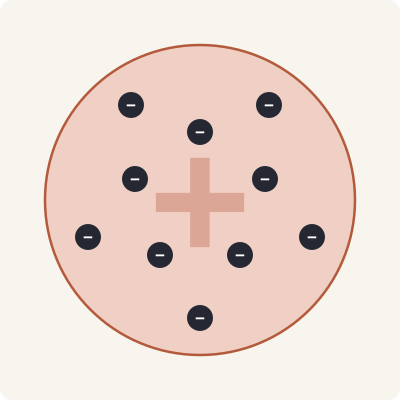
Thomson's Plum Pudding Model
J.J. Thomson name required
Discovered the electron — a negatively charged particle inside the atom. Proposed the plum pudding model: the atom is a ball of positive charge with negative electrons embedded in it.
-
1911
Rutherford's nuclear model
Ernest Rutherford name required
Fired positively charged alpha particles at a thin gold foil. Expected all particles to deflect slightly (as the Plum Pudding model predicted). Instead:
- Most passed straight through → the atom is mostly empty space.
- A tiny proportion deflected at large angles → there is a tiny, dense, positively charged nucleus at the centre.
This disproved the Plum Pudding model and led to the nuclear model of the atom.
Straight through — most particles Deflected — a few Bounced back — very rarePress play to fire a beam of identical alpha particles at the gold foil.
-
1913
Niels Bohr name required
Adapted the nuclear model by suggesting that electrons orbit the nucleus at specific distances (fixed energy levels/shells). The theoretical calculations of Bohr agreed with experimental observations.
-
~1920
Discovery of the Proton (no specific name required)
Later experiments showed that the positive charge of the nucleus could be subdivided into a whole number of smaller particles, each with the same amount of positive charge. These particles were named protons.
-
1932
James Chadwick name required
Provided experimental evidence for the existence of neutrons within the nucleus — particles with the same mass as a proton but no electrical charge. This was about 20 years after the nucleus became an accepted scientific idea.
You must link each observation to its conclusion:
- "Most particles passed straight through" → the atom is mostly empty space.
- "A small proportion deflected at large angles" → there is a tiny, dense, positively charged nucleus. The positive alpha particles were repelled by the positive nucleus.
- The Plum Pudding model predicted all particles would be slightly deflected — this was not what was observed, so the model was rejected.
In Rutherford's experiment, a small number of alpha particles were deflected at large angles. What does this tell us about the structure of the atom? Give two conclusions.
Show answer
- The nucleus is positively charged — the positive alpha particles were repelled by a positive charge at the centre of the atom.
- The nucleus is tiny and dense — only a very small number of particles were deflected, meaning the positive charge is concentrated in a very small region.
The fact that most particles passed straight through also tells us the atom is mostly empty space.
🧪 Exam-style questions
In the plum-pudding model, how was the positive charge arranged? Tick (✓) one box.
Describe one difference between the plum-pudding model and the nuclear model of the atom.
Show answer
- In the plum-pudding model the positive charge is spread out through the whole atom 1 mark
- In the nuclear model the positive charge is concentrated in a tiny central nucleus (with electrons orbiting around it) 1 mark
Allow: plum-pudding has no nucleus / electrons embedded throughout, whereas the nuclear model has a small dense nucleus and mostly empty space.
In the alpha-scattering experiment, most alpha particles passed straight through the gold foil, but a few were deflected through large angles and a very small number bounced straight back. Explain how these results led to the nuclear model.
Show answer
- Most particles passing straight through shows the atom is mostly empty space 1 mark
- The few deflected / repelled show there is a concentrated positive charge (which repels the positive alpha particles) 1 mark
- The very few bouncing back show this positive charge (the nucleus) is tiny but holds most of the mass 1 mark
Allow: the mass is concentrated in a small central nucleus.
Structure of the Atom
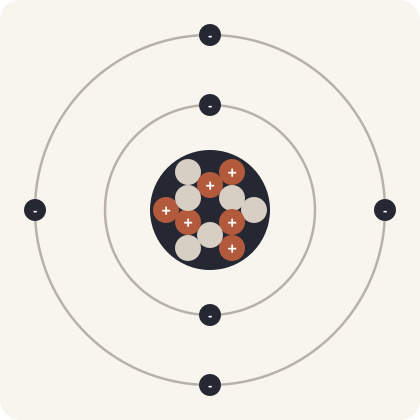
A carbon atom: 6 protons and 6 neutrons in the nucleus, with 6 electrons arranged across two shells (2, 4). Not to scale.
Subatomic Particles
| Particle | Relative Mass | Relative Charge | Location |
|---|---|---|---|
| Proton | 1 | +1 | Nucleus |
| Neutron | 1 | 0 (neutral) | Nucleus |
| Electron | Very small (~1/2000) | −1 | Shells (energy levels) surrounding the nucleus |
A fluorine atom has an atomic number of 9 and a mass number of 19. State the number of: (a) protons, (b) neutrons, (c) electrons in this atom.
Show answer
- (a) Protons = 9 — always equal to the atomic number.
- (b) Neutrons = 19 − 9 = 10 — mass number minus atomic number.
- (c) Electrons = 9 — equal to the number of protons in a neutral atom.
Why Atoms are Electrically Neutral
In a neutral atom, the number of electrons always equals the number of protons. Each proton has charge +1 and each electron has charge −1 — these cancel out exactly, giving a net charge of zero.
Atomic Number and Mass Number
Atomic number (Z) — the number of protons in the nucleus. Every element has a unique atomic number. Elements on the Periodic Table are arranged in order of increasing atomic number. In a neutral atom: protons = electrons.
Mass number (A) — the total number of protons + neutrons in the nucleus.
Number of neutrons = mass number − atomic number
On the Periodic Table, for sodium: mass number = 23, atomic number = 11. So: protons = 11 | neutrons = 23 − 11 = 12 | electrons = 11
Practice — Protons, Neutrons and Electrons
Fill in the Protons, Neutrons and Electrons columns, then click Check answers.
| Element | Z | A | Protons | Neutrons | Electrons |
|---|---|---|---|---|---|
| Helium (He) | 2 | 4 | |||
| Lithium (Li) | 3 | 7 | |||
| Sodium (Na) | 11 | 23 | |||
| Phosphorus (P) | 15 | 31 | |||
| Bromine (Br) | 35 | 80 | |||
| Calcium (Ca) | 20 | 40 |
The number of electrons is not given directly on the Periodic Table — you deduce it from the atomic number (they are equal in a neutral atom). The mass number is always the larger of the two numbers shown.
🧪 Exam-style questions
What is the relative charge of a neutron? Tick (✓) one box.
An atom of argon is represented as 4018Ar. Determine the number of protons, neutrons and electrons it contains.
Show answer
- Protons = atomic number = 18; electrons = 18 (neutral atom) 1 mark
- Neutrons = mass number − atomic number = 40 − 18 = 22 1 mark
Ions
Ion — a charged atom (or group of atoms) formed when an atom gains or loses one or more electrons.
| Type | How formed | Charge | Example |
|---|---|---|---|
| Positive ion (cation) | Atom loses electrons | Positive — fewer electrons than protons | Na → Na⁺ (loses 1e⁻) | Mg → Mg²⁺ (loses 2e⁻) |
| Negative ion (anion) | Atom gains electrons | Negative — more electrons than protons | Cl → Cl⁻ (gains 1e⁻) | O → O²⁻ (gains 2e⁻) |
Working Out Particles in an Ion
The atomic number still gives the number of protons (protons are never gained or lost). The ion's charge tells you how many electrons have been gained or lost.
Atomic number of Cl = 17 → protons = 17
Mass number = 35 → neutrons = 35 − 17 = 18
Charge = 1− (gained 1 electron) → electrons = 17 + 1 = 18
- Protons = atomic number (always — protons are never gained or lost)
- Electrons = protons − ion charge (positive ion → subtract; negative ion → add)
- Neutrons = mass number − atomic number (unchanged by ion formation)
A magnesium ion has the symbol Mg²⁺. Magnesium has atomic number 12 and mass number 24. State the number of protons, neutrons, and electrons in this ion.
Show answer
- Protons = 12 — always equal to the atomic number; protons are never gained or lost.
- Neutrons = 24 − 12 = 12 — mass number minus atomic number; unchanged by ion formation.
- Electrons = 12 − 2 = 10 — Mg²⁺ has lost 2 electrons to become a positive ion, so electrons = protons − charge = 12 − 2 = 10.
🧪 Exam-style questions
An oxygen atom forms an O2− ion. What has happened to its electrons? Tick (✓) one box.
An oxide ion is represented as 168O2−. Determine the number of protons and electrons in this ion.
Show answer
- Protons = atomic number = 8 1 mark
- Electrons = protons + 2 (gained 2 to give the 2− charge) = 10 1 mark
Size of Atoms & the Nucleus
| Atom | Nucleus | |
|---|---|---|
| Radius | ≈ 0.1 nm = 1 × 10⁻¹⁰ m | Less than 1/10 000 of the atom ≈ 1 × 10⁻¹⁴ m |
| Contains most of the mass? | No — electrons have negligible mass | Yes — almost all the mass is in the protons & neutrons |
This means the atom is mostly empty space — a key conclusion from Rutherford's experiment. Despite being tiny, the nucleus accounts for virtually all of the atom's mass.
These numbers are hard to imagine, so compare them to something familiar. If an atom were blown up to the size of a large sports stadium, the nucleus at its centre would be about the size of a pea — and the electrons would whizz around the outer stands. It really brings home how the nucleus is thousands of times smaller than the atom, yet holds nearly all its mass, with the rest being empty space.
1 nm = 1 × 10⁻⁹ m so 0.1 nm = 1 × 10⁻¹⁰ m. Make sure you can convert between nm and m using standard form.
🧪 Exam-style questions
The radius of an atom is about 0.2 nm. Calculate this radius in metres. Give your answer in standard form.
Show answer
- 1 nm = 1 × 10⁻⁹ m, so 0.2 nm = 0.2 × 10⁻⁹ m 1 mark
- = 2 × 10⁻¹⁰ m 1 mark
An atom is sometimes compared to a sports stadium with the nucleus shown as a pea at the centre. Suggest what two things this comparison helps you to picture about an atom.
Show answer
- The nucleus is extremely small compared with the whole atom (radius less than 1/10 000 of the atom) 1 mark
- The atom is mostly empty space (the electrons occupy the rest, far from the nucleus) 1 mark
Allow: nearly all of the atom's mass is in that tiny central nucleus.
Isotopes & Relative Atomic Mass
Isotopes — atoms of the same element with the same number of protons but a different number of neutrons. They have the same atomic number but different mass numbers.
- Same chemical properties — identical electron arrangement → identical chemistry.
- Slightly different physical properties — different masses → slightly different density, melting point etc.
- Some isotopes have unstable nuclei and are radioactive (a physical, not chemical, property).
A definition only earns the marks if it is complete. Saying isotopes "have different numbers of neutrons" is not enough on its own — you must also state they are atoms of the same element (the same number of protons). Don't call isotopes "elements," and don't swap the roles of protons and neutrons.
Chlorine Isotopes — A Comparison
| 35Cl (Chlorine-35) | 37Cl (Chlorine-37) | |
|---|---|---|
| Protons | 17 | 17 |
| Neutrons | 18 | 20 |
| Electrons | 17 | 17 |
| Same element? | Yes — both have 17 protons, so both are chlorine. | |
| Isotopes? | Yes — different number of neutrons (18 vs 20). | |
Relative Atomic Mass (Aᵣ)
Because an element often exists as a mixture of isotopes, the Ar shown on the Periodic Table is a weighted average mass of all its naturally occurring isotopes, taking into account their relative abundances. This is why chlorine has an Ar of 35.5 — it sits between its two isotopes (Cl-35 and Cl-37).
Calculating Aᵣ from Isotope Abundances
You need to be able to calculate Ar when given the masses and percentage abundances of each isotope:
Ar = sum of (isotope mass × % abundance)100
Chlorine has two naturally occurring isotopes:
| Isotope | Atomic mass | % Abundance |
|---|---|---|
| 35Cl | 35 | 75% |
| 37Cl | 37 | 25% |
Ar = (35 × 75) + (37 × 25)100
= 2625 + 925100 = 35.5
This matches the value shown on the Periodic Table.
Isotopes do not have different chemical properties. Chemical properties depend on the number and arrangement of electrons — which is identical for all isotopes of an element. Only physical properties (mass, density) differ.
Boron has two naturally occurring isotopes: boron-10 (20% abundance) and boron-11 (80% abundance). Calculate the relative atomic mass of boron. Give your answer to 1 decimal place.
Show answer
Ar = (10 × 20 + 11 × 80) ÷ 100
= (200 + 880) ÷ 100
= 1080 ÷ 100 = 10.8
This matches the value shown for boron on the Periodic Table.
🧪 Exam-style questions
An atom of lithium is represented as 73Li. How many neutrons does it contain?
The atomic number of an element tells you the number of…
18O and 16O are isotopes of oxygen. Which statement is correct?
16O and 18O are both isotopes of oxygen. Give three ways in which the structures of these two atoms compare.
Show answer
- Both have 8 protons (accept: same number of protons) 1 mark
- Both have 8 electrons (accept: same number of electrons) 1 mark
- 18O has 10 neutrons while 16O has 8 neutrons (accept: different numbers of neutrons / 18O has two more neutrons) 1 mark
Examiner tip: maximum 2 marks if no numbers are given, and any numbers you do give must be correct.
Electronic Structures
Electrons occupy energy levels (shells) surrounding the nucleus. Shells fill from the innermost (lowest energy) outwards. The arrangement of electrons is called the electronic structure or electron configuration.
- Count the total number of electrons using the atomic number.
- The 1st shell holds a maximum of 2 electrons.
- The 2nd and 3rd shells each hold a maximum of 8 electrons.
- Always fill the lowest energy shell first before moving to the next.
Sodium (Na) — atomic number 11, so 11 electrons:
1st shell: 2 | 2nd shell: 8 | 3rd shell: 1 → 2, 8, 1
Sulfur (S) — atomic number 16, so 16 electrons:
1st shell: 2 | 2nd shell: 8 | 3rd shell: 6 → 2, 8, 6
First 20 Elements
Tap or hover over any element to see its electron shell diagram.
Metals are generally on the left and centre of the periodic table. Non-metals are generally on the right. Hydrogen is the main exception: it is placed on the left but behaves as a non-metal.
Link to the Periodic Table
| Pattern | Rule |
|---|---|
| Group number | = number of electrons in the outermost shell (Groups 1–7) |
| Period number | = number of occupied electron shells |
| Same group | Same number of outer electrons → similar chemical properties |
| Group 0 (Noble gases) | Full outer shells → very unreactive |
If given the configuration 2, 8, 6, you can immediately identify: Group 6 (6 outer electrons) · Period 3 (3 shells) · the element is Sulfur.
Interactive · Electronic structure
Fill the shells
Pick an element (atomic numbers 1–20), then type how many electrons go in each shell — filling from the inside out. The shell diagram builds as you type. Check your answer to reveal the element's group and period.
Electrons placed: 0 / 12
Write the electronic structure for each of the following elements, then state which group and period they are in:
(a) Oxygen (atomic number 8) (b) Aluminium (atomic number 13) (c) Potassium (atomic number 19)
Show answer
- (a) Oxygen: 2, 6 — Group 6, Period 2
- (b) Aluminium: 2, 8, 3 — Group 3, Period 3
- (c) Potassium: 2, 8, 8, 1 — Group 1, Period 4
Note: the 3rd shell fills to 8 before electrons enter the 4th shell.
The periodic table is really a pattern of outer-shell electrons. Everything that follows — why Group 1 metals react alike, why Group 7 sit together, why the noble gases are unreactive — comes straight back to this one idea: same number of outer electrons → same group → similar chemical properties. Hold onto it, and the rest of this topic falls into place.
🧪 Exam-style questions
Chlorine has the electronic structure 2,8,7. In which group of the periodic table is chlorine found?
Fluorine (2,7) and chlorine (2,8,7) are in the same group. This is because their atoms have the same number of…
An atom of aluminium has 13 electrons.(a) Write its electronic structure. (b) State which group it is in.
Show answer
- (a) Electronic structure = 2,8,3 1 mark
- (b) Group 3 — the outer shell holds 3 electrons 1 mark