Structure and bonding can feel familiar quite quickly. You might know the headline definitions: ionic bonding involves electron transfer, covalent bonding involves shared pairs of electrons, and metallic bonding involves delocalised electrons.
But exam questions often test something slightly different. They ask whether you can choose the correct model for the substance in front of you, then use that model to explain a property.
That is where marks are often lost. You might know the right facts, but apply them to the wrong structure: calling sodium chloride a molecule, saying covalent bonds are weak, or using intermolecular forces to explain diamond.
Before you answer a structure and bonding question, work through these questions:
- Do I have metals, non-metals, or a combination?
- What type of bonding does that give?
- What structure does that bonding give?
- What forces or attractions are involved?
- Which properties follow from that?
First, the key words matter
In structure and bonding, small words are not interchangeable. If a question needs ions and you write molecules, the rest of the answer can fall apart.
| Key word | Meaning | Example |
|---|---|---|
| Atom | A single particle of an element. | A carbon atom in diamond. |
| Element | A substance containing only one type of atom. | Magnesium, chlorine or carbon. |
| Compound | A substance made from two or more different elements chemically joined together. | Sodium chloride or carbon dioxide. |
| Ion | A charged particle formed when an atom or group of atoms loses or gains electrons. | Na+ or Cl−. |
| Molecule | A particle made from atoms covalently bonded together. | Cl2, H2O or CO2. |
Sodium chloride contains ions, not molecules. Chlorine gas contains molecules: Cl2. Diamond contains atoms in a giant covalent structure. The particle type shapes every answer that follows.
Start from the KS3 particle model
You already know that particles in solids, liquids and gases are arranged differently and have different amounts of energy. GCSE structure and bonding makes that more precise. It asks: what are the particles, how are they arranged, and what forces hold them together? Answer that, and properties like melting point and conductivity become straightforward to explain.
Question 1: do I have metals, non-metals, or a combination?
Periodic table
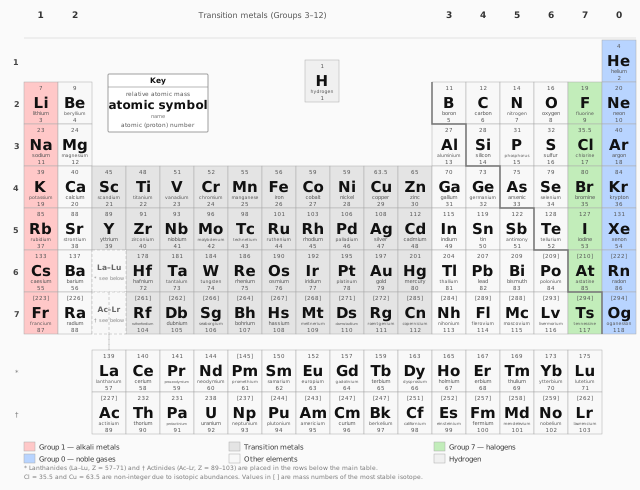
Start by looking at the elements in the formula. Use the periodic table. Elements on the left on the stepped line are metals (with the exception of hydrogen). Elements on the right are non-metals. This is the first hurdle, because it points you towards the bonding model you should use.
| Elements involved | Usual bonding | Key idea |
|---|---|---|
| Metal + non-metal | Ionic bonding | Electrons are transferred, forming oppositely charged ions. |
| Non-metal + non-metal | Covalent bonding | Atoms share pairs of electrons. |
| Metal element | Metallic bonding | Positive metal ions are attracted to delocalised electrons. |
For example, sodium chloride contains a metal and a non-metal, so you should be thinking about ionic bonding. Carbon dioxide contains non-metals only, so you should be thinking about covalent bonding. Copper is a metal element, so you should be thinking about metallic bonding.
This step stops you mixing models. For example, saying magnesium transfers electrons to oxygen and then shares electrons combines ionic and covalent bonding in the same answer, which costs marks.
Question 2: what structure does that bonding produce?
Bonding tells you how particles are joined or attracted. Structure tells you how those particles are arranged overall.
| Substance type | Bonding | Structure |
|---|---|---|
| Metal + non-metal | Ionic | Giant ionic lattice |
| Most non-metal + non-metal substances | Covalent | Simple molecular |
| Diamond, graphite and silicon dioxide | Covalent | Giant covalent structure |
| Metal element | Metallic | Giant metallic structure |
The word covalent is not enough on its own. Carbon dioxide is covalent and simple molecular. Diamond is covalent and giant covalent. They have different properties because they have different structures.
At GCSE, the giant covalent structures you are most likely expected to recognise are diamond, graphite and silicon dioxide. If a covalent substance is not one of those, it is usually safest to think simple molecular unless the question gives you extra information.
Question 3: what forces or attractions matter?
Once you know the structure, you can choose the correct force or attraction. This is where many exam answers become too vague.
| Structure | Forces or attractions | Typical property explanation |
|---|---|---|
| Giant ionic lattice | Strong electrostatic forces between oppositely charged ions. | High melting point because lots of energy is needed to overcome the attractions. |
| Simple molecular | Weak intermolecular forces between molecules. | Low boiling point because little energy is needed to overcome the forces between molecules. |
| Giant covalent | Strong covalent bonds between atoms. | High melting point because lots of energy is needed to break covalent bonds. |
| Giant metallic | Metallic bonding between positive metal ions and delocalised electrons. | Conducts electricity because delocalised electrons can move and carry charge. |
The most important trap is this: simple molecular substances do not have weak covalent bonds. They have strong covalent bonds within each molecule, but weak intermolecular forces between molecules.
Chlorine, Cl2, has strong covalent bonds within each molecule. When it boils, those bonds are not broken: only the weak intermolecular forces between molecules are overcome.
A useful rule is: no molecules, no intermolecular forces. Diamond does not contain molecules, so do not explain diamond using intermolecular forces.
Question 4: what property am I being asked about?
Now apply the model to the property in the question. Do not start with a memorised phrase. Build the explanation from the structure.
| Question | Model | Exam-style answer |
|---|---|---|
| Why does sodium chloride have a high melting point? | Ionic → giant ionic lattice → strong electrostatic forces. | Sodium chloride has a giant ionic lattice. There are strong electrostatic forces of attraction between oppositely charged sodium ions and chloride ions. A lot of energy is needed to overcome these forces, so sodium chloride has a high melting point. |
| Why does chlorine have a low boiling point? | Covalent → simple molecular → weak intermolecular forces. | Chlorine is a simple molecular substance. There are weak intermolecular forces between chlorine molecules. Little energy is needed to overcome these forces, so chlorine has a low boiling point. |
| Why does diamond have a high melting point? | Covalent → giant covalent → strong covalent bonds. | Diamond has a giant covalent structure. Each carbon atom is joined to other carbon atoms by strong covalent bonds. A lot of energy is needed to break these covalent bonds, so diamond has a very high melting point. |
| Why do metals conduct electricity? | Metallic → giant metallic structure → delocalised electrons. | Metals contain delocalised electrons that can move through the structure and carry electrical charge. |
Notice that the better answers are not just longer. They are more specific. They name the particles, structure and forces that belong to that substance.
Structure and bonding is not a set of definitions to memorise separately. It is one connected model: identify the elements, determine the bonding, identify the structure, name the forces, then explain the property. Each step leads to the next, and that chain is what earns the marks.