From C3 Quantitative Chemistry you already know moles, Mr, concentration and (if you did Triple Science) percentage yield and atom economy, and from C4 the titration method. A-Level keeps the ideas and upgrades the machinery: the ideal gas equation pV = nRT replaces the fixed “24 dm3 per mole” shortcut, concentrations are handled in mol dm−3 as standard, and titrations now come with concordance rules and percentage uncertainty.
Relative atomic & molecular mass
All relative masses are measured on the same scale, anchored to a single standard: an atom of carbon-12 is defined as exactly 12. Because they are ratios of one mass to another, relative masses have no units.
Relative atomic mass, Ar — the average mass of one atom of an element divided by 1/12 of the mass of one atom of carbon-12.
Relative molecular mass, Mr — the average mass of one molecule divided by 1/12 of the mass of one atom of carbon-12.
The word average is doing real work in the Ar definition: it is a weighted mean over the element’s isotopes, exactly the calculation you carried out from mass spectra in Atomic Structure. That is why chlorine’s Ar of 35.5 is not a whole number.
You never memorise Ar values: every exam paper comes with a data sheet carrying the periodic table below, with Ar printed above each symbol. Note that values are quoted to one decimal place — at GCSE most were rounded to whole numbers, so iron is now 55.8 (not 56) and potassium 39.1 (not 39) — and your working must use them exactly as printed. A value in square brackets, such as [222] for radon, is the mass number of the most stable isotope of an element that has no stable ones.
Periodic table as printed in the exam data sheet
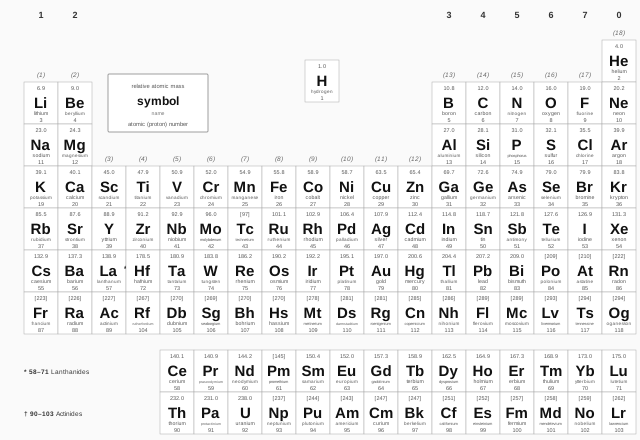
To find Mr, add up the Ar of every atom in the formula. For compounds made of ions — which have no molecules — the same sum is called the relative formula mass, and it is calculated over one formula unit:
Mr(Na2CO3) = (2 × 23.0) + 12.0 + (3 × 16.0) = 106.0
Mr(MgSO4·7H2O) = 24.3 + 32.1 + (4 × 16.0) + (7 × 18.0) = 246.4
- Two anchored parts in every definition — the average mass (isotopes exist, so single atoms differ), compared to 1/12 of one atom of carbon-12. Not “a carbon atom”, and not hydrogen.
- Water of crystallisation counts in a relative formula mass — the “·7H2O” in MgSO4·7H2O adds 126.0.
- No units, ever. Relative masses are ratios, so writing “g” after an Ar makes the statement wrong.
Exam questions
What is the relative molecular mass (Mr) of benzene-1,4-dicarboxylic acid? Tick (✓) one box.
Source: AQA A-Level Chemistry past papers.
The mole & the Avogadro constant
Atoms are far too small to count, so chemists count them in fixed-size batches. One batch is a mole: the amount of substance that contains as many particles as there are atoms in exactly 12 g of carbon-12. That number is the Avogadro constant, L = 6.022 × 10²³ mol−1 (the 6.02 × 10²³ you met at GCSE, carrying one more figure) — you are given its value in the exam, so learn how to use it, not the digits.
The Avogadro constant, L — the number of particles in one mole of substance: 6.022 × 10²³ mol−1.
Two conversions cover almost everything. Between mass and moles:
n = mass m (g)Mr
This only works with the mass in grams, so convert first:
1 tonne = 1 × 106 g · 1 kg = 1 × 103 g · 1 mg = 1 × 10⁻³ g
So a tonne-scale industrial quantity — say 2.00 tonnes of sodium chloride — becomes:
n = 2.00 × 10658.5 = 3.42 × 10⁴ mol
Between moles and particle counts:
number of particles = n × L
The mole applies to whatever entity you name — atoms, molecules, ions, electrons or formula units — so name it. One mole of Mg(OH)2 contains one mole of Mg2+ ions and two moles of OH− ions; forming one mole of Al3+ ions from aluminium atoms removes three moles of electrons.
How many chloride ions are in 9.53 g of magnesium chloride, MgCl2? (Ar: Mg 24.3, Cl 35.5)
Step 1 — moles of MgCl2 from the mass:
Mr(MgCl2) = 24.3 + (2 × 35.5) = 95.3
n(MgCl2) = 9.5395.3 = 0.100 mol
Step 2 — moles of the named particle (this is where the ratio bites):
each MgCl2 holds two Cl−, so n(Cl−) = 2 × 0.100 = 0.200 mol
Step 3 — convert moles to a count with L:
0.200 × 6.022 × 1023 = 1.20 × 10²³ ions (3 sf)
Skip the ×2 and you halve the answer — naming the particle (Cl−, not MgCl2) is what forces you to apply it.
Calculate the mass, in grams, of a single atom of sodium-23.
Step 1 — one atom is one L-th of a mole:
m = 23.0 ÷ (6.022 × 10²³) = 3.82 × 10⁻²³ g
Sense-check the size: one atom must come out unimaginably small, around 10−22–10−23 g — if your answer is large, you inverted the division. This is the same move the TOF routine on Atomic Structure makes in kilograms — there you divide by a further 1000.
- Match the significant figures to the least accurate measurement — here the mass (9.53 g, 3 sf) caps the answer at 3 sf. The full rules are next.
- Give answers involving L in standard form — and practise keying powers of ten into your calculator correctly.
Exam questions
1-iodopropane, CH3CH2CH2I (Mr = 169.9), is a liquid at room temperature. Calculate the number of molecules in 5.0 cm3 of 1-iodopropane. Give your answer in standard form.
For 1-iodopropane, density = 1.75 g cm−3. The Avogadro constant, L = 6.022 × 10²³ mol−1.
Show answer
mass = 5.0 × 1.75 = 8.75 g → n = 8.75 ÷ 169.9 = 0.0515 mol
Density turns the volume into a mass; Mr turns the mass into moles 1 mark
molecules = 0.0515 × 6.022 × 1023 = 3.10 × 10²²
Moles × L, answer in standard form 1 mark
The answer must be in standard form, as the question asks — allow 3.10–3.13 × 10²² (at least 2 sf).
A sample of cyclohexane contains 3.011 × 1024 atoms of carbon. What is the mass of this sample? The Avogadro constant, L = 6.022 × 10²³ mol−1 Tick (✓) one box.
Source: AQA A-Level Chemistry past papers.
Standard form & significant figures
Numbers like 6.022 × 10²³ make two maths skills unavoidable, and AQA assesses both inside this topic: writing numbers in the right form, and quoting answers to the right precision. Calculation mark schemes apply them from the first question, so they are worth learning properly rather than absorbing by osmosis.
Standard form
Standard form writes every number as A × 10n, where A is between 1 and 10. To convert, move the decimal point until only one non-zero digit is left in front of it, counting the moves: a big number takes a positive power, a number smaller than 1 takes a negative power.
34 200 mol = 3.42 × 10⁴ mol 0.00250 g = 2.50 × 10⁻³ g
Two working habits stop standard form costing marks. First, multiplying powers of ten adds the indices and dividing subtracts them — a quick way to sanity-check a calculator answer. Second, key numbers in with the ×10x (or EXP/EE) button rather than typing “×10^”, and bracket any denominator you divide by — 6 ÷ (8.31 × 373), not 6 ÷ 8.31 × 373.
Significant figures
Significant figures measure how precisely a value is claimed to be known. Three counting rules cover every case:
- Start counting at the first non-zero digit — the leading zeros in 0.00408 are placeholders, not precision, so it has 3 significant figures (the captive zero between the 4 and the 8 counts).
- Trailing zeros after a decimal point DO count — writing 2.50 g instead of 2.5 g is a claim that you measured to the nearest 0.01 g.
- In standard form, every digit of A is significant — which is exactly why standard form is the unambiguous way to quote a rounded value.
For answers, one rule decides: quote to the same number of significant figures as the least precise data value in the question — a calculated result can never be more certain than its weakest measurement. And round once, at the final answer: carry full calculator values between steps.
One caveat: that rule is for multiplying and dividing, which covers almost every mole calculation. Pure addition and subtraction (summing masses, subtracting burette readings) goes by decimal places instead: 0.154 g + 0.01234 g = 0.166 g, quoted to the nearest 0.001 g like the less precise mass.
2.65 g of anhydrous sodium carbonate (Mr 106.0) is dissolved and made up to 500 cm3 in a volumetric flask. State the concentration to an appropriate number of significant figures.
Step 1 — moles, then concentration:
n = 2.65 ÷ 106.0 = 0.0250 mol → c = 0.0250 ÷ 0.500 = 0.05 (calculator display)
Step 2 — match the precision to the data. The mass (2.65 g) is the least precise value at 3 sf:
c = 0.0500 mol dm−3 (3 sf)
The calculator drops the trailing zeros; you must put them back. 0.05 claims only 1 significant figure of certainty — less than the data supports.
Interactive — sig figs & standard form, quick-fire
The Bridge the Gap maths module walks both skills through more slowly, with practice questions, if they feel rusty.
- Match the answer to the least precise input — data given to 3 sf cannot justify a 5-sf answer.
- Trailing zeros are a claim — do not drop ones you have earned (0.0500, not 0.05) or add ones you have not.
- Standard form keeps A between 1 and 10 — 24.1 × 10²² is not standard form; write 2.41 × 10²³.
- Round once, at the very end — and if a question gives data to mixed precision, let the weakest value set the answer.
Concentration of solutions
The second way to measure out an amount in moles is by volume of a solution of known concentration. Concentration is the amount of solute per cubic decimetre (litre) of solution, in mol dm−3 — the same unit you wrote as mol/dm3 at GCSE, now in negative-index notation:
c = n (mol)V (dm3) so n = c × V
Volumes are measured in cm3 at the bench, so divide by 1000 before substituting: 25.0 cm3 = 0.0250 dm3. A concentration in g dm−3 converts to mol dm−3 by dividing by the molar mass — and back again by multiplying.
5.30 g of anhydrous sodium carbonate is dissolved and made up to exactly 250 cm3. Find the concentration in mol dm−3 and in g dm−3.
Step 1 — moles of solute:
n(Na2CO3) = 5.30 ÷ 106.0 = 0.0500 mol
Step 2 — volume into dm3, then divide:
c = 0.0500 ÷ 0.250 = 0.200 mol dm−3
Step 3 — mass concentration, if asked:
0.200 × 106.0 = 21.2 g dm−3
This is exactly the calculation behind making a standard solution in Required Practical 1.
Diluting a solution adds water but no solute, so the amount in moles is unchanged. Take 25.0 cm3 of the 0.200 mol dm−3 solution above and make it up to 100 cm3 — the moles stay put:
n = 0.200 × 0.0250 = 5.00 × 10⁻³ mol
Spread those same moles through the new, larger volume and the concentration drops:
c = 5.00 × 10−30.100 = 0.0500 mol dm−3
- Volumes enter in dm3 (cm3 ÷ 1000) — the unit mol dm−3 is the reminder.
- State the unit. “Concentration” on its own is ambiguous — say mol dm−3 or g dm−3.
- Show the moles-are-constant step in a dilution, rather than quoting a memorised c1V1 = c2V2 with no reasoning.
Exam questions
When driving a car, a legal limit for ethanol (Mr = 46.0) is 80 mg per 100 cm3 of blood. What is this concentration in mol dm−3? Tick (✓) one box.
Source: AQA A-Level Chemistry past papers.
The ideal gas equation
The third and final way to measure an amount in moles works for a gas. An ideal gas is a simple model — particles of negligible volume, with no forces between them — that real gases follow closely at ordinary temperatures and pressures. For an ideal gas, pressure, volume, amount and temperature are tied together by a single equation:
pV = nRT
The catch is units. You are given R = 8.31 J K−1 mol−1 on the data sheet, and that value only balances the equation when every other quantity goes in in its matching SI unit — pascals, cubic metres and kelvin:
| Quantity | SI unit | Convert into SI |
|---|---|---|
| p, pressure | Pa | kPa × 103 |
| V, volume | m3 | cm3 × 10−6; dm3 × 10−3 |
| n, amount | mol | — |
| R, gas constant | 8.31 J K−1 mol−1 | given — not recalled |
| T, temperature | K | °C + 273 |
The kelvin deserves a closer look, because it is not just another unit — it is the Celsius scale re-zeroed. A kelvin is exactly the same size as a degree Celsius; the only difference is where zero sits. Celsius puts 0 at water’s freezing point — convenient, but arbitrary. Kelvin puts 0 at absolute zero (−273 °C), the temperature where particles have the minimum possible energy. That is why a kelvin temperature is never negative, and why it is the scale the ideal gas equation is built on: double the kelvin temperature and you really have doubled the particles’ kinetic energy.
Every temperature that enters a calculation in A-Level Chemistry goes in as kelvin. The one exception is a change in temperature: because the two scales tick at the same rate, ΔT comes out identical in kelvin or Celsius — a rise from 25 °C to 35 °C is a rise of 10 °C and 10 K — so a thermometer’s Celsius change can be used directly in energetics.
Rearrange before you substitute, and write the rearranged form down as a line of working:
n = pVRTV = nRTpT = pVnR
The GCSE shortcut falls straight out of this equation. Put one mole at room conditions (293 K, 101 kPa) and:
V = nRTp = 1 × 8.31 × 2931.01 × 105 = 0.0241 m3 ≈ 24 dm3
The “24 dm3 per mole” you memorised was pV = nRT in disguise, frozen at one temperature and pressure — A-Level swaps the number for the machinery, which works at any conditions.
The classic application pairs the equation with a weighed sample: measure the volume a known mass of vapour occupies, find n, then divide the mass by n to get the relative molecular mass Mr.
0.140 g of a volatile liquid vaporises completely to give 60.0 cm3 of vapour at 100 °C and 100 kPa. Find its relative molecular mass and suggest an identity.
Step 1 — convert every quantity to SI units first:
p = 1.00 × 10⁵ Pa V = 6.00 × 10⁻⁵ m3 T = 373 K
Step 2 — rearrange for n and substitute:
n = pVRT = 1.00 × 105 × 6.00 × 10−58.31 × 373 = 1.94 × 10⁻³ mol
Step 3 — divide the mass by the amount to get Mr (carrying the unrounded 1.9357 × 10⁻³):
Mr = 0.1401.9357 × 10−3 = 72.3 — consistent with pentane, C5H12 (Mr 72.0)
A gas has a density of 1.78 g dm−3 at 298 K and 100 kPa. Find its relative molecular mass.
Step 1 — a density in g dm−3 is the mass of exactly 1 dm3, so take that 1 dm3 as the sample:
V = 1.00 × 10⁻³ m3 m = 1.78 g
Step 2 — find the amount from pV = nRT:
n = pVRT = 1.00 × 105 × 1.00 × 10−38.31 × 298 = 0.0404 mol
Step 3 — divide the mass by the amount:
Mr = 1.780.0404 = 44.1 — carbon dioxide, CO2, fits
Taking exactly 1 dm3 needs no new formula and keeps the units honest.
Examiner reports flag unit conversion as a recurring source of lost marks across calculation work — and pV = nRT is where it bites hardest. The three classic slips:
- kPa left as kPa instead of × 103 into Pa.
- cm3 turned into dm3 when the SI unit is m3 (cm3 × 10−6).
- a Celsius temperature used directly — kelvin is not optional, because the equation is built on an absolute scale, so 100 °C must enter as 373 K.
Convert before you substitute, and write the converted values down as their own line.
Interactive — get the units into SI before you substitute
Exam questions
This question is about two experiments on gases. In the first experiment, liquid Y is injected into a sealed flask under vacuum. The liquid vaporises in the flask. The table shows data for this experiment.
| Mass of Y | 717 mg |
| Temperature | 297 K |
| Volume of flask | 482 cm3 |
| Pressure inside flask | 51.0 kPa |
Calculate the relative molecular mass of Y. Show your working. The gas constant, R = 8.31 J K−1 mol−1.
Show answer
n = pVRT
Rearranged expression written down 1 mark
p = 51.0 × 10³ Pa V = 4.82 × 10⁻⁴ m3
Both unit conversions into SI 1 mark
n = (51.0 × 103 × 4.82 × 10−4) ÷ (8.31 × 297) = 9.96 × 10⁻³ mol
Amount of Y 1 mark
mass = 717 mg = 0.717 g
Mass converted to grams 1 mark
Mr = 0.717 ÷ 9.96 × 10−3 = 72.0
Final answer (at least 2 sf) 1 mark
72.0 with no working scores no marks — the steps are assessed individually, which is why every conversion gets its own line.
In the second experiment, another flask is used for a combustion reaction.
- Remove all the air from the flask.
- Add 0.0010 mol of 2,2,4-trimethylpentane (C8H18) to the flask.
- Add 0.0200 mol of oxygen to the flask.
- Spark the mixture to ensure complete combustion.
- Cool the mixture to the original temperature.
The equation is C8H18(g) + 12½O2(g) → 8CO2(g) + 9H2O(l)
Calculate the amount, in moles, of gas in the flask after the reaction.
Show answer
n(CO2) = 8 × 0.0010 = 0.0080 mol
Carbon dioxide formed 1 mark
n(O2 left) = 0.0200 − (12.5 × 0.0010) = 0.0075 mol → total = 0.0075 + 0.0080 = 0.0155 mol
Leftover excess oxygen added to the products 1 mark
The water is a liquid at the original temperature — its 9 × 0.0010 mol adds nothing to the gas total. Miss the leftover O2 and the whole second mark goes.
M is a Group 2 metal that forms the nitrate M(NO3)2. 0.320 g of M(NO3)2 is heated strongly and decomposes completely.
2M(NO3)2(s) → 2MO(s) + 4NO2(g) + O2(g)
The mixture of gases formed has a volume of 225 cm3 at 450 °C and 101 000 Pa. Determine the Mr of M(NO3)2. Identify M. The gas constant, R = 8.31 J K−1 mol−1.
Show answer
V = 2.25 × 10⁻⁴ m3 T = 450 + 273 = 723 K
Unit conversions 1 mark
n(gas) = pVRT = (101 000 × 2.25 × 10−4) ÷ (8.31 × 723) = 3.78 × 10⁻³ mol
Total moles of gas produced 1 mark
n(M(NO3)2) = 3.78 × 10−3 × 25 = 1.51 × 10⁻³ mol
Equation ratio — 2 mol of nitrate make 5 mol of gas (4NO2 + O2) 1 mark
Mr = 0.320 ÷ 1.51 × 10−3 = 211.9 (allow 211.5–212)
Relative formula mass 1 mark
Ar(M) = 211.9 − 124.0 = 87.9 → M is strontium
Subtract two NO3 groups (2 × 62.0 = 124.0) and identify a Group 2 metal 1 mark
The identity is marked consequentially on your Mr — but it must be a Group 2 metal.
Source: AQA A-Level Chemistry past papers.
Empirical & molecular formulae
Empirical formula — the simplest whole number ratio of atoms of each element in a compound.
Molecular formula — the actual number of atoms of each element in a compound.
Composition data — masses or percentages by mass — leads to the empirical formula by one fixed routine: divide each element’s mass by its Ar (giving moles), then divide every result by the smallest, then clear any stubborn decimals by multiplying up (a ratio ending in .5 doubles; .33 or .67 triples; .25 or .75 quadruples).
The molecular formula is a whole-number multiple of the empirical formula. Find the multiple by dividing Mr by the empirical formula mass.
A compound is 40.0% carbon, 6.70% hydrogen and 53.3% oxygen by mass, and its Mr is 180. Find the empirical and molecular formulae.
Step 1 — take 100 g, so percentages become masses; divide by each Ar:
C: 40.0 ÷ 12.0 = 3.33 H: 6.70 ÷ 1.0 = 6.70 O: 53.3 ÷ 16.0 = 3.33
Step 2 — divide by the smallest:
C: 1 H: 2.01 O: 1 → empirical formula CH2O (mass 30.0)
Step 3 — scale to the molecular formula with Mr:
180 ÷ 30.0 = 6 → molecular formula C6H12O6
0.300 g of compound X, containing carbon, hydrogen and oxygen only (Mr = 60.0), burns completely to give 0.440 g of CO2 and 0.180 g of H2O. Find the molecular formula of X.
Step 1 — every C ends up in CO2, every H in H2O (two H per molecule):
n(C) = 0.440 ÷ 44.0 = 0.0100 mol (= 0.120 g of C)
n(H) = 2 × (0.180 ÷ 18.0) = 0.0200 mol (= 0.0200 g of H)
Step 2 — oxygen comes by difference (never from the O2 supplied, which is in excess):
m(O) = 0.300 − 0.120 − 0.0200 = 0.160 g → n(O) = 0.0100 mol
Step 3 — ratio, then scale with Mr:
C : H : O = 1 : 2 : 1 → CH2O (mass 30.0); 60.0 ÷ 30.0 = 2 → C2H4O2
The factor of 2 on n(H) is the classic slip — each H2O carries two hydrogens.
A salt can carry water the same fixed-ratio way. Water of crystallisation is water built into the crystal structure of a salt in a fixed mole ratio: a salt containing it is hydrated, one without is anhydrous, and the dot in a formula like CuSO4·5H2O means five moles of water per mole of salt — part of the formula, counted in the relative formula mass (as above).
To find how much water a hydrated salt holds, heat it to constant mass — reheat and reweigh until two successive masses agree, which shows all the water has gone — and the mass lost is the water. The same moles-then-ratio routine then gives x. Heating is the route for a salt like MgSO4 that has no acid–base reaction of its own; a hydrate that does react in a titration — a hydrated acid such as H2C2O4·xH2O, or a carbonate like washing soda Na2CO3·xH2O — can reach x by titration instead.
2.46 g of hydrated magnesium sulfate, MgSO4·xH2O, is heated to constant mass, leaving 1.20 g of anhydrous MgSO4. Find x. (Mr: MgSO4 120.4, H2O 18.0)
Step 1 — moles of each component:
n(MgSO4) = 1.20 ÷ 120.4 = 9.97 × 10⁻³ mol
n(H2O) = (2.46 − 1.20) ÷ 18.0 = 0.0700 mol
Step 2 — ratio of water to salt:
x = 0.0700 ÷ 9.97 × 10−3 = 7.02 → x = 7, so the salt is MgSO4·7H2O
- Keep mole ratios unrounded until the final step — a ratio of 1.33 is 4/3 (multiply by 3), not “about 1”.
- An empirical formula must be the simplest whole-number ratio — C2H4O2 to an empirical-formula question scores nothing, even though the ratio is right.
- “Heated to constant mass” has a precise meaning — reheat and reweigh until the mass stops changing, the evidence that dehydration (or decomposition) is complete.
Exam questions
A compound contains 40.0% carbon, 6.7% hydrogen and 53.3% oxygen by mass. Which could be the molecular formula of this compound? Tick (✓) one box.
5.0 g of an oxide contains 4.0 g of molybdenum. What is the empirical formula of this oxide? (Ar: Mo 96.0, O 16.0) Tick (✓) one box.
Compound L (Mr = 88.0) contains carbon, hydrogen and oxygen only. A 6.56 × 10⁻⁴ mol sample of L burns completely in air to form 2.62 × 10⁻³ mol of water and 2.62 × 10⁻³ mol of carbon dioxide. Deduce the formula of L. Show your working.
Show answer
C per molecule = 2.62 × 10⁻³ ÷ 6.56 × 10−4 = 4
Every C ends up in CO2 1 mark
H per molecule = (2 × 2.62 × 10−3) ÷ 6.56 × 10−4 = 8
Two H per H2O — the classic ×2 1 mark
mass of C4H8 = (4 × 12.0) + (8 × 1.0) = 56.0 → O = (88.0 − 56.0) ÷ 16.0 = 2
Oxygen by difference from Mr 1 mark
L is C4H8O2
Molecular formula 1 mark
This question hands you moles instead of masses — the routine is the same combustion analysis as the worked example above, one step shorter.
Which compound has the same empirical formula and molecular formula? Tick (✓) one box.
Complete combustion of 0.0100 mol of an organic acid produced 0.0200 mol of carbon dioxide. The same amount of the acid required 20 cm3 of 1.00 mol dm−3 NaOH(aq) for neutralisation. Which could be the formula of the acid? Tick (✓) one box.
Source: AQA A-Level Chemistry past papers.
Formulae & equations
A balanced equation is a statement about moles: 2Mg + O2 → 2MgO says two moles of magnesium consume one mole of oxygen molecules. Every calculation in the rest of this topic stands on that reading — which makes writing correct formulae and balanced equations the foundation skill of the course.
Formulae come first
No equation balances if the formulae in it are wrong. The charge on most ions can be read straight from the periodic table — only the polyatomic ions follow no pattern, and those have to be recalled cold:
Charge = the group number
Charge = the group number − 8
No pattern and no shortcut — recall these cold. Manganate(VII) and dichromate(VI) do heavy lifting in Year 2 redox.
Alongside the ions, the formulae of the common acids need recalling on sight: HCl, H2SO4 and HNO3.
The compound must be neutral, so multiply the ions up until the charges cancel, and bracket any repeated polyatomic ion — the last row is the double-balance case where both ions need multiplying:
| Ions | Formula | Charge check |
|---|---|---|
| Fe3+ and O2− | Fe2O3 | 2(3+) + 3(2−) = 0 |
| Al3+ and NO3− | Al(NO3)3 | (3+) + 3(1−) = 0 |
| NH4+ and SO42− | (NH4)2SO4 | 2(1+) + (2−) = 0 |
| Fe3+ and SO42− | Fe2(SO4)3 | 2(3+) + 3(2−) = 0 |
Build an ionic formula
Pick a positive and a negative ion, then add ions of each until the charges cancel exactly. No ion-charge sheet exists at A-Level — the charges have to live in your head, so treat every round as recall practice.
Balancing unfamiliar equations
With correct formulae in place, balancing is bookkeeping: count each element across both sides and adjust the coefficients — the big numbers in front, never a subscript inside a formula — until every count matches. AQA expects you to balance unfamiliar reactions whenever the reactants and products are named, so the routine matters more than the examples you happen to know. Work element by element, leaving whichever appears in the most places (usually oxygen or hydrogen) until last — and if the last element needs half a molecule, allow the fraction, then double everything.
Balancing is only possible once you know what is made. These general patterns cover most of the inorganic reactions AQA expects you to write unprompted:
| General reaction | Example |
|---|---|
| substance + oxygen → oxide(s) | C3H8 + 5O2 → 3CO2 + 4H2O |
| metal + water → metal hydroxide + hydrogen | 2Na + 2H2O → 2NaOH + H2 |
| metal + acid → salt + hydrogen | Mg + 2HCl → MgCl2 + H2 |
| metal oxide + acid → salt + water | MgO + 2HNO3 → Mg(NO3)2 + H2O |
| hydroxide + acid → salt + water | 2NaOH + H2SO4 → Na2SO4 + 2H2O |
| carbonate + acid → salt + water + carbon dioxide | CuCO3 + 2HCl → CuCl2 + H2O + CO2 |
| hydrogencarbonate + acid → salt + water + carbon dioxide | KHCO3 + HCl → KCl + H2O + CO2 |
| ammonia + acid → ammonium salt | NH3 + HCl → NH4Cl |
| metal carbonate → metal oxide + carbon dioxide (on heating) | CaCO3 → CaO + CO2 |
Ammonia burns in oxygen over a platinum catalyst to give nitrogen monoxide and water — the first step of nitric acid manufacture. Balance the equation: NH3 + O2 → NO + H2O
Step 1 — nitrogen already matches (1 : 1), so balance hydrogen: 3 on the left, 2 on the right, lowest common multiple 6:
2NH3 + O2 → NO + 3H2O → nitrogen now needs re-balancing: 2NH3 + O2 → 2NO + 3H2O
Step 2 — oxygen last: the right holds 2 + 3 = 5 O atoms, so allow half an O2:
2NH3 + 52O2 → 2NO + 3H2O
Step 3 — clear the fraction by doubling every coefficient, then re-count everything:
4NH3 + 5O2 → 4NO + 6H2O (N: 4 = 4 H: 12 = 12 O: 10 = 4 + 6 ✓)
Re-balancing an earlier element after a later change — as nitrogen was in step 1 — is normal, not a mistake. The final re-count is what catches anything left behind.
Interactive — balance it yourself, with a live atom count
| Element | Left | Right |
|---|
Ionic equations
Ionic equations strip a full equation down to the species that actually change, with spectator ions removed. The routine: write the full balanced equation with state symbols; split only the aqueous ionic compounds into their ions (solids, liquids, gases and covalent molecules stay whole); cancel anything unchanged on both sides; check that atoms and total charge balance. For zinc displacing copper:
full equation Zn(s) + CuSO4(aq) → ZnSO4(aq) + Cu(s)
split the (aq) ionic compounds Zn(s) + Cu2+(aq) + SO42−(aq) → Zn2+(aq) + SO42−(aq) + Cu(s)
ionic equation Zn(s) + Cu2+(aq) → Zn2+(aq) + Cu(s)
The sulfate ion appears unchanged on both sides — a spectator — so it is cancelled, exactly like striking a common term from both sides of a maths equation.
Four neutralisation ionic equations are worth knowing on sight — and note the hydrogencarbonate one takes only one H+:
acid + hydroxide H+(aq) + OH−(aq) → H2O(l)
acid + carbonate 2H+(aq) + CO32−(aq) → H2O(l) + CO2(g)
acid + hydrogencarbonate H+(aq) + HCO3−(aq) → H2O(l) + CO2(g)
acid + ammonia H+(aq) + NH3(aq) → NH4+(aq)
Precipitation reactions reduce to just the two ions that combine — Ag+(aq) + Cl−(aq) → AgCl(s), or Ba2+(aq) + SO42−(aq) → BaSO4(s), the sulfate test you will meet again in Group 2. If no combination of ions is insoluble, mixing the two salt solutions gives no reaction at all.
How many H+ an acid supplies also fixes reacting ratios: monoprotic HCl, HNO3 and CH3COOH react 1 : 1 with NaOH, diprotic H2SO4 reacts 1 : 2, and with carbonates the count runs the other way — Na2CO3 needs two HCl but only one H2SO4.
Exam questions
Ammonia is oxidised as shown.
w NH3 + x O2 → y H2O + z NO
Which whole number values for w, x, y and z balance the equation? Tick (✓) one box.
Which compound needs the greatest amount of oxygen for the complete combustion of 1 mol of the compound? Tick (✓) one box.
Source: AQA A-Level Chemistry past papers.
Calculations from equations
Every quantitative question in this topic follows the same three-step method: convert what you know into moles → use the ratio from the equation → convert back out to a mass, a gas volume or a concentration. At GCSE you may have run that logic through a results table; at A-Level, set the same steps out as lines of working — that is where method marks live.
Reacting mass calculations
The three-step method turns a known mass of any substance in an equation into the mass of any other — the workhorse calculation of the whole course. Industrial questions hand you kilograms or tonnes; convert to grams first (kg × 103, tonne × 106) and the method is unchanged.
What mass of magnesium oxide forms when 4.86 g of magnesium ribbon burns completely? 2Mg + O2 → 2MgO. (Ar: Mg 24.3, O 16.0)
Step 1 — moles of what you know:
n(Mg) = 4.86 ÷ 24.3 = 0.200 mol
Step 2 — use the equation ratio (2 : 2, so 1 : 1):
n(MgO) = 0.200 mol
Step 3 — convert back out to a mass:
mass = 0.200 × 40.3 = 8.06 g (3 sf)
Percentage yield
A reacting-mass calculation gives the theoretical maximum — the mass the equation promises if nothing is lost. Comparing what the reaction actually delivered against that maximum gives the percentage yield, and the comparison works in grams or in moles, as long as top and bottom match:
% yield = actual amount of producttheoretical amount of product × 100
The magnesium burn above was run as an experiment, and the magnesium oxide collected weighed 7.35 g. Find the percentage yield.
Step 1 — actual ÷ theoretical:
% yield = 7.358.06 × 100 = 91.2%
Yields fall below 100% for practical reasons: the reaction may be incomplete or reversible, side reactions divert reactants into other products, and some product is always lost in transfers and purification.
Exam questions
Compound P is converted into compound R by a two-stage synthesis via compound Q. The yields for the individual steps are: P → Q 50%, and Q → R 30%. What is the overall yield of R in this synthesis? Tick (✓) one box.
Propylamine is synthesised by the reaction of 1-iodopropane with an excess of ammonia:
CH3CH2CH2I + 2NH3 → CH3CH2CH2NH2 + NH4I
In an experiment, 10.3 g of 1-iodopropane (Mr = 169.9) are reacted with an excess of ammonia. 2.3 g of propylamine (Mr = 59.0) are produced. Calculate the percentage yield in this experiment.
Show answer
n(1-iodopropane) = 10.3 ÷ 169.9 = 0.0606 mol n(propylamine) = 2.3 ÷ 59.0 = 0.0390 mol
Both amounts in moles — ammonia is in excess, so the iodopropane fixes the theoretical yield 1 mark
% yield = 0.03900.0606 × 100 = 64% (allow 63.9–64.4%)
Actual ÷ theoretical × 100, using the 1 : 1 ratio 1 mark
Working in masses is equally credited: theoretical mass = 0.0606 × 59.0 = 3.58 g, then 2.3 ÷ 3.58 × 100 — same answer.
Nitration of 1.70 g of methyl benzoate (Mr = 136.0) produces methyl 3-nitrobenzoate (Mr = 181.0). The percentage yield is 65.0%. What mass, in g, of methyl 3-nitrobenzoate is produced? Tick (✓) one box.
Source: AQA A-Level Chemistry past papers.
Limiting reagents
When both reactant quantities are given, one of them is completely used up first — the limiting reagent — and the reactant left over is in excess. Once the limiting reagent runs out the reaction stops, so every product calculation must start from it. Never find a “theoretical yield” by adding reactant masses together (a method error called out in examiner reports). The test: convert both to moles, divide each by its equation coefficient, and the smallest quotient is the limiting reagent.
These molecules drift freely. Choose how many H2 and O2 to start with, then press React.
750 g of TiCl4 reacts with 120 g of magnesium: TiCl4 + 2Mg → Ti + 2MgCl2. Find the maximum mass of titanium formed. (Mr: TiCl4 189.9; Ar: Mg 24.3, Ti 47.9)
Step 1 — moles of each reactant, divided by its coefficient:
n(TiCl4) = 750 ÷ 189.9 = 3.95 mol (÷1 → 3.95)
n(Mg) = 120 ÷ 24.3 = 4.94 mol (÷2 → 2.47, the smaller — Mg is limiting)
Step 2 — all products from the limiting reagent:
n(Ti) = 4.94 ÷ 2 = 2.47 mol → mass = 2.47 × 47.9 = 118 g (3 sf)
Mg has more moles than TiCl4 yet still runs out first — the coefficients decide, not the masses or even the moles.
Exam questions
Calcium sulfide reacts with calcium sulfate as shown.
CaS + 3CaSO4 → 4CaO + 4SO2
2.50 g of calcium sulfide are heated with 9.85 g of calcium sulfate until there is no further reaction. Show that calcium sulfate is the limiting reagent in this reaction. Calculate the mass, in g, of sulfur dioxide formed. (Mr: CaS 72.2, CaSO4 136.2)
Show answer
n(CaS) = 2.50 ÷ 72.2 = 0.0346 mol
Moles of CaS 1 mark
n(CaSO4) = 9.85 ÷ 136.2 = 0.0723 mol
Moles of CaSO4 1 mark
0.0346 mol of CaS needs 3 × 0.0346 = 0.104 mol of CaSO4 — more than the 0.0723 mol available
Justification that CaSO4 is limiting (or via quotients: 0.0723 ÷ 3 = 0.0241 < 0.0346 ÷ 1) 1 mark
n(SO2) = 0.0723 × 43 = 0.0964 mol
All products from the limiting reagent 1 mark
mass = 0.0964 × 64.1 = 6.18 g
Convert out with Mr(SO2) = 64.1 1 mark
“Show that” means the numbers and the comparison must be on the page — state which reagent limits and why, not just two mole values.
Source: AQA A-Level Chemistry past papers.
Reacting gas volumes
The same three steps convert a mass into a gas volume — find the moles of gas from the equation ratio, then let pV = nRT turn moles into a volume at the stated conditions:
5.00 g of calcium carbonate decomposes completely: CaCO3 → CaO + CO2. What volume does the CO2 occupy at 298 K and 100 kPa? (Mr: CaCO3 100.1)
Step 1 — moles of gas from the equation ratio (1 : 1):
n(CO2) = 5.00 ÷ 100.1 = 0.0500 mol
Step 2 — ideal gas equation, rearranged for V, SI units in:
V = nRTp = 0.0500 × 8.31 × 2981.00 × 105 = 1.24 × 10⁻³ m3
Step 3 — convert to bench units if asked:
1.24 × 10⁻³ m3 × 1000 = 1.24 dm3
One corollary of pV = nRT does a lot of quiet work. At a fixed temperature and pressure everything except n stays constant, so gas volume is directly proportional to moles — and the volume ratios of reacting gases are the mole ratios of the equation. No conversion to moles is needed at all: work directly in cm3.
The most demanding version fires a fuel in excess oxygen and asks for the total volume of gas remaining once the reaction is complete — demanding because it means tracking the leftover excess as well as the products:
50 cm3 of propane is reacted with 400 cm3 of oxygen (an excess) and the mixture returns to room temperature. All volumes are measured at the same temperature and pressure. What total volume of gas remains?
C3H8(g) + 5O2(g) → 3CO2(g) + 4H2O(l)
Step 1 — oxygen used, straight from the 1 : 5 volume ratio:
V(O2 used) = 5 × 50 = 250 cm3
Step 2 — oxygen left over, because it was in excess:
V(O2 left) = 400 − 250 = 150 cm3
Step 3 — gaseous products, checking states at room temperature:
V(CO2) = 3 × 50 = 150 cm3; the water is a liquid at room temperature, so it adds no gas volume
Step 4 — total what survives:
150 + 150 = 300 cm3 of gas in total
The state of the water is the trap. In a question run above 100 °C it stays as steam and counts: 4 × 50 = 200 cm3 more, for 500 cm3 in total. Read the temperature before you total.
Interactive — find the gas left over, one step at a time
The logic runs both ways: measured volume ratios confirm an equation’s coefficients, and coefficients predict volumes. This holds only at one fixed temperature and pressure — it is not a licence for GCSE-style molar-volume shortcuts.
Exam questions
What is the minimum volume, in dm3, of air needed for the complete combustion of 1 dm3 of methane? Assume that air contains 20% of oxygen by volume, and that all volumes are measured at the same temperature and pressure. Tick (✓) one box.
Magnesium reacts with hydrochloric acid.
Mg(s) + 2HCl(aq) → MgCl2(aq) + H2(g)
0.400 g of magnesium is added to 20.0 cm3 of 1.50 mol dm−3 hydrochloric acid. Identify the limiting reagent. Justify your answer. Calculate the volume, in m3, of hydrogen produced at 101 kPa and 15 °C. The gas constant, R = 8.31 J K−1 mol−1.
Show answer
n(Mg) = 0.400 ÷ 24.3 = 0.0165 mol
Moles of magnesium 1 mark
n(HCl) = 1.50 × 0.0200 = 0.0300 mol
Moles of acid 1 mark
0.0165 mol of Mg would need 2 × 0.0165 = 0.0330 mol of HCl — so HCl is the limiting reagent
Identification with justification (or via quotients: 0.0300 ÷ 2 = 0.0150 < 0.0165) 1 mark
n(H2) = 0.0300 ÷ 2 = 0.0150 mol
Hydrogen from the limiting reagent 1 mark
T = 15 + 273 = 288 K p = 101 000 Pa
Unit conversions 1 mark
V = nRTp = (0.0150 × 8.31 × 288) ÷ 101 000
Rearranged and substituted 1 mark
V = 3.55 × 10⁻⁴ m3
Final answer (at least 2 sf) 1 mark
Using the GCSE “1 mol = 24 dm3” shortcut cannot score the last three marks — 15 °C and 101 kPa are not the conditions that number was frozen at.
Propane (C3H8) undergoes complete combustion in a plentiful supply of oxygen. Give an equation for the complete combustion of propane. Use this equation to calculate the minimum volume, in cm3, of oxygen gas needed for the complete combustion of 50 cm3 of propane gas. Assume that the volumes of both gases are measured at the same temperature and pressure.
Show answer
C3H8 + 5O2 → 3CO2 + 4H2O
Balanced equation (multiples and fractions allowed) 1 mark
V(O2) = 5 × 50 = 250 cm3
Volume ratio = mole ratio at fixed conditions 1 mark
Source: AQA A-Level Chemistry past papers.
Atom economy
Atom economy judges a reaction by design rather than by performance: what fraction of the total mass of reactants ends up in the product you actually want?
% atom economy = Mr of desired productsum of Mr of all reactants × 100
Titanium is extracted by TiCl4 + 2Mg → Ti + 2MgCl2. Find the percentage atom economy for titanium. (Ar: Ti 47.9, Cl 35.5, Mg 24.3)
Step 1 — masses across the balanced equation, coefficients included:
desired product: Ti = 47.9 all reactants: 189.9 + (2 × 24.3) = 238.5
Step 2 — apply the definition:
% atom economy = 47.9238.5 × 100 = 20.1%
Nearly four-fifths of the reactant mass leaves as MgCl2. The process only pays because the by-product is electrolysed back to magnesium and chlorine for reuse — exactly the economic and environmental logic AQA expects you to discuss.
High-atom-economy processes matter to society and industry alike. AQA words the benefits as economic, ethical and environmental — reproduce all three strands in a discussion answer:
- Economic — fewer atoms wasted means less raw material bought, and less by-product to separate, transport and dispose of.
- Ethical — wasting fewer of the Earth’s finite resources, and leaving less waste for others, is a fairness question as well as a financial one.
- Environmental — a more sustainable process overall.
Addition reactions, where every reactant atom joins the product, have an atom economy of 100%; substitution and decomposition routes are inherently lower.
- Yield and atom economy answer different questions — yield measures how well the reaction went (product lost); atom economy is fixed by the equation before you touch a flask. A reaction can run at 100% yield and still waste most of its atoms.
- Include the balancing coefficients in the reactant masses of an atom-economy sum.
- Theoretical yield always comes from the limiting reactant — check which one runs out first whenever both quantities are given.
Exam questions
What is the percentage atom economy for the production of ethanol from glucose? Tick (✓) one box.
C6H12O6 → 2C2H5OH + 2CO2
What is the percentage atom economy for the formation of sodium nitrate in the reaction between sodium carbonate and nitric acid? Tick (✓) one box.
Na2CO3 + 2HNO3 → 2NaNO3 + H2O + CO2
The equation for a process used to manufacture the refrigerant trichlorofluoromethane (CCl3F) is
SbF3Br2 + CCl4 → CCl3F + SbF2Br2Cl
Calculate the percentage atom economy for the production of CCl3F in this reaction. Give your answer to 3 significant figures.
Show answer
% atom economy = 137.5338.6 + 154.0 × 100 = 137.5492.6 × 100
Correct expression — Mr(CCl3F) = 137.5 over the sum of both reactants 1 mark
= 27.9%
Answer to exactly 3 sf, as asked 1 mark
Unfamiliar formulae change nothing — build each Mr from the periodic table (SbF3Br2 = 121.8 + 57.0 + 159.8 = 338.6) and apply the definition. Either 137.5 or 492.6 correct in the working can still earn the first mark.
Source: AQA A-Level Chemistry past papers.
Titrations & Required Practical 1
Make up a volumetric solution of accurately known concentration, and carry out a simple acid–base titration. The apparatus and technique below — and the titre analysis that follows — are all fair game in the practical-skills questions of Papers 1, 2 and 3 — see the required practicals page.
Making the standard solution. The whole point is a solution whose concentration you know exactly — so nothing must be lost along the way:
- Weigh by difference — weigh the boat before and after tipping the solid in; the difference is exactly what went into the beaker.
- Dissolve in a beaker with less water than the final volume, stirring with a glass rod.
- Transfer with washings — pour into a volumetric flask through a funnel, then rinse the beaker, the rod and the funnel into the flask too, so no solute is left behind.
- Make up to the line — add water to within a centimetre of the graduation, then finish drop by drop with a teat pipette until the bottom of the meniscus sits on the line at eye level.
- Mix — stopper and invert repeatedly.
With the standard solution made, the titration itself is next. Run it here — the flask holds acid with a few drops of phenolphthalein (colourless), and the burette delivers the alkali, the way AQA sets this indicator up in recent papers (the vinegar and citric-acid questions below do exactly this). Near the end-point each drop lands in a flash of pink that fades as you swirl. The drop that leaves the first pale pink that stays is the end-point — record there. Any more alkali is in excess: past the end-point the pink only deepens, and the titre reads high.
Interactive — run the titration and build your own titre table
| Run | Initial / cm3 | Final / cm3 | Titre / cm3 |
|---|
Running the titration. Rinse each piece of glassware with the solution it will hold — the burette with the titrant, the pipette with the solution being measured — but the conical flask only ever with distilled water. Extra water in the flask changes no amounts in moles; leftover rinse solution would.
After filling, run titrant through the tap so the jet below the tap is full of liquid before you take the initial reading — an air bubble that escapes mid-run inflates the apparent titre.
Add 2–3 drops of indicator to the flask — phenolphthalein (pink in alkali, colourless in acid) and methyl orange are the standard choices. Which indicator suits which acid–base pair is a story for Acids & Bases (3.1.12). Run a quick rough titration first, then repeat accurately, adding dropwise near the end-point with constant swirling over a white tile, until the indicator just changes permanently.
Burettes are read to the nearest 0.05 cm3. Repeat until you have two concordant titres — within 0.10 cm3 of each other — and average only the concordant ones, ignoring the rough titre and any outlier:
| Rough | Run 1 | Run 2 | Run 3 | |
|---|---|---|---|---|
| Titre / cm3 | 22.90 | 22.45 | 22.60 | 22.35 |
| Used in the mean? | ✗ rough | ✓ | ✗ not concordant | ✓ |
mean titre = 22.45 + 22.352 = 22.40 cm3
Interactive — pick the concordant titres, then find the mean
Because a titre is the difference between two burette readings, its uncertainty is twice the reading uncertainty: 2 × ±0.05 = ±0.10 cm3. As a percentage of the mean titre — the percentage uncertainty (you may have met it as “percentage error”):
% uncertainty = 0.1022.40 × 100 = 0.45%
A larger titre makes the same ±0.10 cm3 proportionally smaller — so diluting the titrant or using a larger aliquot reduces the percentage uncertainty.
The end-point is a mole balance: the titre is fixed by the moles of substance in the flask and the concentration of the solution in the burette — not by how much water happens to be around. That one idea answers a whole family of exam questions.
- Extra water in the conical flask changes nothing. The pipette fixes the moles of analyte; adding distilled water dilutes it but leaves those moles untouched, so the same titre still reaches the end-point. (Rinsing the flask with the analyte would be different — that adds moles and inflates the titre, which is why the flask is only ever rinsed with water.)
- Diluting the solution in the burette does change the titre. A more dilute titrant carries fewer moles per cm3, so it takes a larger volume to deliver the same moles — the titre goes up. Rinse the burette with the titrant, never water, or an unaccounted dilution throws the result off.
- To cut the percentage uncertainty, deliberately dilute the titrant (or pipette a larger aliquot) so the titre is bigger — the fixed ±0.10 cm3 is then a smaller fraction of it. Just use the new, lower concentration in the calculation.
- A funnel left in the burette reads too low. If a drip falls from the funnel into the burette mid-run, the level falls by less than the volume actually delivered to the flask — so the titre comes out smaller than the true value. Remove the funnel before taking the initial reading.
- An air bubble in the jet reads too high. If a bubble below the tap fills with liquid part-way through the run, the level falls by the bubble’s volume without that liquid reaching the flask — so the titre comes out larger than the true value. Run the jet full before the initial reading to avoid it.
Exam questions
The table shows some results from a titration. What is the correct mean titre? Tick (✓) one box.
| Titration | Rough | Titre 1 | Titre 2 | Titre 3 |
|---|---|---|---|---|
| Initial reading / cm3 | 0.00 | 11.30 | 0.00 | 8.55 |
| Final reading / cm3 | 26.85 | 37.20 | 26.20 | 34.55 |
| Titre volume / cm3 | 26.85 | 25.90 | 26.20 | 26.00 |
A student completes a titration to determine the concentration of ethanoic acid in vinegar. 25.0 cm3 of vinegar are transferred to a conical flask using a pipette. A few drops of phenolphthalein are added to the conical flask. Sodium hydroxide solution is added from a burette to the conical flask. The titration is repeated until concordant results are obtained. Which suggestion decreases the percentage uncertainty in the mean titre? Tick (✓) one box.
In the same vinegar titration, which suggestion improves the accuracy of the titres? Tick (✓) one box.
A student uses this method to prepare a standard solution of sodium carbonate.
- Weigh a clean, dry, empty container on a balance that reads to 2 decimal places.
- Add about 2.5 g of solid sodium carbonate to the container.
- Tip the solid into a beaker.
- Add approximately 100 cm3 of distilled water to the beaker and stir until all the solid has dissolved.
- Pour the solution into a 250 cm3 volumetric flask.
- Add distilled water until the top of the meniscus is level with the graduation mark.
Suggest three improvements to this method.
Show answer
Any three of: 1 mark each
- Weigh by difference — reweigh the container after tipping (or wash the solid from the container into the beaker), so the mass actually transferred is known.
- Transfer with washings — rinse the beaker (and stirring rod) with distilled water and add the washings to the volumetric flask.
- Read the bottom of the meniscus — make up so the bottom of the meniscus sits on the graduation mark (using a dropping pipette near the mark).
- Mix thoroughly — stopper the flask and invert it several times after making up to the mark.
Record all masses to the balance’s 2 decimal places is also credited. Suggestions must fix the method — apparatus swaps are ignored.
A different student uses the correct method to prepare 250 cm3 of sodium carbonate solution in a volumetric flask. The uncertainty for the volumetric flask is ±0.20 cm3. Calculate the percentage uncertainty in the volume of this sodium carbonate solution.
Show answer
% uncertainty = 0.20250 × 100 = 0.080% 1 mark
Citric acid reacts with sodium hydroxide.
C6H8O7(aq) + 3NaOH(aq) → Na3C6H5O7(aq) + 3H2O(l)
A student makes a solution of citric acid by dissolving some solid citric acid in water. Describe a method to add an accurately known mass of solid to a beaker to make a solution.
Show answer
Weigh the container (weighing boat) with the solid in it 1 mark
Add the solid to the beaker, reweigh the empty container, and subtract to find the mass added 1 mark
Equally credited: zero (tare) the balance with the container on it, then reweigh after tipping; or weigh the solid directly into the beaker on a zeroed balance. The idea being tested is weighing by difference — the mass that left the container is what you know accurately.
The student dissolves 0.834 g of citric acid in water and makes the solution up to 500 cm3. Calculate the concentration, in mol dm−3, of citric acid in this solution.
Show answer
Mr(C6H8O7) = (6 × 12.0) + (8 × 1.0) + (7 × 16.0) = 192.0
Relative molecular mass from the formula 1 mark
n = 0.834 ÷ 192.0 = 4.34 × 10⁻³ mol
Moles of citric acid 1 mark
c = 4.34 × 10⁻³ ÷ 0.500 = 8.69 × 10⁻³ mol dm−3
Divide by the volume in dm3 1 mark
The student uses this method to complete a titration.
- Rinse a burette with distilled water.
- Fill the burette with sodium hydroxide solution.
- Use a measuring cylinder to transfer 25 cm3 of the citric acid solution into a conical flask.
- Add 5 cm3 of indicator.
- Slowly add the sodium hydroxide solution from the burette into the conical flask.
- Add the sodium hydroxide solution dropwise near the end point until the indicator just changes colour.
- Repeat the titration to get concordant results.
The method used by the student includes three practical steps that will lead to an inaccurate final result. For each of these three steps: identify the mistake, explain why it is a mistake, and suggest how the mistake can be overcome. This is a levels-of-response question — you are marked on how completely and coherently each mistake–problem–fix triple is developed.
Show a model answer
How it is marked (levels of response):
- Level 3 (5–6): three mistakes covered, each with a generally correct and virtually complete explanation and fix, in a well-structured answer.
- Level 2 (3–4): three mistakes covered incompletely, or two covered well.
- Level 1 (1–2): two mistakes covered incompletely, or one covered well.
The faulty steps (the mark scheme credits the best three of these four):
- Measuring cylinder for the 25 cm3 — far too large an uncertainty for volumetric work → use a volumetric pipette.
- 5 cm3 of indicator — indicator is itself a weak acid/base, so that much can react and shift the end point → use 2–6 drops.
- Burette rinsed with distilled water — residual water dilutes the sodium hydroxide, inflating the titre → rinse the burette with the sodium hydroxide solution.
- Stopping when the indicator “just” changes colour — without swirling, the acid may not have fully reacted → add until a single drop gives a permanent colour change (with swirling).
Each mistake needs its consequence and its fix — naming the faulty step alone is Level 1 territory.
The table shows the student’s burette readings after the mistakes in the practical procedure have been corrected. Complete the table. Use the data in the table to calculate the mean titre.
| Rough | Run 1 | Run 2 | Run 3 | |
|---|---|---|---|---|
| Final reading / cm3 | 23.65 | 22.95 | 46.05 | 26.30 |
| Start reading / cm3 | 0.00 | 0.00 | 22.95 | 3.40 |
| Titre / cm3 | 23.65 |
Show answer
Titres: Run 1 = 22.95 Run 2 = 23.10 Run 3 = 22.90 cm3
All three titres correct 1 mark
mean of the concordant titres = (22.95 + 22.90) ÷ 2 = 22.93 cm3 (allow 22.925)
Runs 1 and 3 are within 0.10 cm3; Run 2 (and the rough) are excluded 1 mark
The total uncertainty in the use of the burette is ±0.15 cm3. Calculate the percentage uncertainty in the use of the burette in Run 1.
Show answer
% uncertainty = 0.1522.95 × 100 = 0.65% 1 mark
The ±0.15 cm3 is given as the total for the burette here — no doubling needed. When a question gives the per-reading uncertainty instead, two readings means ×2 first.
Source: AQA A-Level Chemistry past papers.
Titration calculations
With concordant titres banked, the calculation is the familiar three-step method wearing a solutions costume: moles of titrant from c × V, across the equation ratio, back out to whatever the question wants.
Vinegar is too concentrated to titrate neatly, so 25.0 cm3 of it is diluted to exactly 250 cm3. A 25.0 cm3 aliquot of the diluted vinegar needs a mean titre of 22.40 cm3 of 0.100 mol dm−3 sodium hydroxide: CH3COOH + NaOH → CH3COONa + H2O. Find the concentration of ethanoic acid in the original vinegar.
Step 1 — moles of titrant delivered:
n(NaOH) = 0.100 × 0.02240 = 2.24 × 10⁻³ mol
Step 2 — use the equation ratio (1 : 1) for the aliquot:
n(CH3COOH in 25.0 cm3) = 2.24 × 10⁻³ mol
Step 3 — concentration of the diluted solution:
c(diluted) = 2.24 × 10⁻³ ÷ 0.0250 = 0.0896 mol dm−3
Step 4 — undo the ×10 dilution:
c(vinegar) = 0.0896 × 10 = 0.896 mol dm−3 (= 0.896 × 60.0 = 53.8 g dm−3)
Every titration so far has used a 1 : 1 equation, where the stoichiometry step does no work. Check the ratio — and its direction — every time: examiner reports flag ratio slips, dividing when you should multiply, among the most common titration errors.
A 25.0 cm3 aliquot of sodium carbonate solution needs a mean titre of 23.60 cm3 of 0.150 mol dm−3 hydrochloric acid: Na2CO3 + 2HCl → 2NaCl + H2O + CO2. Find the concentration of the sodium carbonate.
Step 1 — moles of titrant:
n(HCl) = 0.150 × 0.02360 = 3.54 × 10⁻³ mol
Step 2 — use the equation ratio, 2 HCl per Na2CO3, so divide by 2:
n(Na2CO3) = 3.54 × 10⁻³ ÷ 2 = 1.77 × 10⁻³ mol
Step 3 — concentration of the aliquot:
c = 1.77 × 10⁻³ ÷ 0.0250 = 0.0708 mol dm−3
Your turn — the table method. A 25.0 cm3 aliquot of sodium carbonate solution needs a mean titre of 27.40 cm3 of 0.150 mol dm−3 hydrochloric acid. The grid works exactly like the one you used at GCSE — each box unlocks the next:
Na2CO3 + 2HCl → 2NaCl + H2O + CO2
| HClknown | Na2CO3find this | |
|---|---|---|
| Ratio | ||
| Moles | ||
| Conc. | 0.150mol dm−3 · given | mol dm−3 |
| Volume | 27.40 cm3= 0.02740 dm3 | 25.0 cm3= 0.0250 dm3 |
Exam questions
The reaction between vanadium(IV) ions and manganate(VII) ions in acidic solution can be represented by the equation
5V4+ + MnO4− + 8H+ → 5V5+ + Mn2+ + 4H2O
What volume, in dm3, of 0.020 mol dm−3 KMnO4 is needed to oxidise 0.10 mol of vanadium(IV) ions completely? Tick (✓) one box.
The concentration of dilute hydrochloric acid can be found by titration using a standard solution of barium hydroxide. Calculate the mass, in g, of solid barium hydroxide (Mr = 171.3) needed to prepare 250 cm3 of 0.100 mol dm−3 barium hydroxide solution.
Show answer
mass = 0.100 × 0.250 × 171.3 = 4.28 g (allow 4.3) 1 mark
The mass of barium hydroxide from part (a) is dissolved in a beaker containing 150 cm3 of distilled water. Describe how this solution is used to make 250 cm3 of the 0.100 mol dm−3 barium hydroxide solution.
Show answer
Transfer the solution to a 250 cm3 volumetric (graduated) flask 1 mark
Rinse the beaker with distilled water, add the washings, and make up to the graduation mark with distilled water 1 mark
Stopper and invert several times (shake) to mix 1 mark
Before the first titration, the 25 cm3 pipette is rinsed with a small volume of the 0.100 mol dm−3 barium hydroxide solution. State why it is good practice to rinse the pipette in this way.
Show answer
So that residual water does not dilute the solution — the titration is then done with a known concentration of barium hydroxide 1 mark
Hydrochloric acid is added to the burette using a funnel. State why it is good practice to remove the funnel from the burette before the titration.
Show answer
Drops of acid could fall from the funnel into the burette during the run — the titre would then read smaller than the volume actually delivered 1 mark
“Decreases the titre” is credited; “changes the titre” alone is not, and “increases the titre” is wrong — this is the funnel-drip case from the callout above.
In a different experiment, 0.952 g of solid barium hydroxide is used to make 250 cm3 of standard barium hydroxide solution. 25.0 cm3 of this barium hydroxide solution reacts with exactly 24.50 cm3 of hydrochloric acid. Calculate the concentration of the hydrochloric acid.
Show answer
n(Ba(OH)2) in 25.0 cm3 = 0.952171.3 ÷ 10 = 5.56 × 10⁻⁴ mol
Moles in the flask, scaled to the aliquot 1 mark
Ba(OH)2 + 2HCl → BaCl2 + 2H2O → n(HCl) = 2 × 5.56 × 10−4 = 1.11 × 10⁻³ mol
The 1 : 2 ratio — each Ba(OH)2 carries two OH− 1 mark
c(HCl) = 1.11 × 10⁻³ ÷ 0.02450 = 0.045 mol dm−3
Divide by the titre in dm3 1 mark
The uncertainty in the 25.0 cm3 of solution from the pipette is ±0.05 cm3. The total uncertainty in the 24.50 cm3 of solution from the burette is ±0.15 cm3. Calculate the total percentage error in using the pipette and burette.
Show answer
(0.0525.0 + 0.1524.50) × 100 = 0.20 + 0.61 = 0.81% 1 mark
Percentage uncertainties from separate pieces of apparatus add.
A student is provided with a 5.60 g sample of ethanoic acid (CH3COOH) contaminated with sodium ethanoate (CH3COONa). The student dissolves the sample in deionised water and makes the volume up to 200 cm3. The student removes 25.0 cm3 samples of the solution and titrates them with 0.350 mol dm−3 sodium hydroxide solution. The table shows the results of these titrations.
| Rough | 1 | 2 | 3 | |
|---|---|---|---|---|
| Final volume / cm3 | 20.85 | 41.10 | 20.50 | 40.80 |
| Initial volume / cm3 | 0.00 | 20.85 | 0.00 | 20.50 |
| Titre / cm3 | 20.85 | 20.25 | 20.50 | 20.30 |
Use the results in the table to calculate the mean titre value. Use the mean titre to calculate the percentage by mass of sodium ethanoate in the original sample.
Show answer
mean titre = (20.25 + 20.30) ÷ 2 = 20.28 cm3
Concordant titres only — 1 and 3 (allow 20.275) 1 mark
n(NaOH) = 0.350 × 0.02028 = 7.10 × 10⁻³ mol = n(CH3COOH) in 25.0 cm3
Only the acid reacts with NaOH (1 : 1) — the sodium ethanoate is already a salt 1 mark
n(CH3COOH) in 200 cm3 = 7.10 × 10−3 × 8 = 0.0568 mol
Scale the aliquot to the whole flask (200 ÷ 25 = ×8) 1 mark
mass of CH3COOH = 0.0568 × 60.0 = 3.41 g
Mass of the acid in the sample 1 mark
mass of CH3COONa = 5.60 − 3.41 = 2.19 g
The contaminant is what’s left of the 5.60 g 1 mark
% by mass = 2.195.60 × 100 = 39.2% (allow 39.1–39.2)
Final percentage 1 mark
The student rinses the burette with deionised water before filling with sodium hydroxide solution. State and explain the effect, if any, that this rinsing will have on the value of the titre.
Show answer
The titre would increase 1 mark
because the residual water dilutes the sodium hydroxide — fewer moles per cm3, so a larger volume is needed to deliver the same moles 1 mark
Source: AQA A-Level Chemistry past papers.
Back titrations
Some samples cannot be titrated directly — calcium carbonate in limestone or an indigestion tablet is insoluble, and reacts with acid too slowly for a sharp end-point. The workaround is to react the sample with a measured excess of acid, then titrate what is left over: the acid used by the sample is the difference.
Reach for a back titration only when a direct one won’t work:
| Direct titration | Back titration | |
|---|---|---|
| Use when… | the sample dissolves and reacts quickly, giving a sharp end-point | the sample is insoluble (limestone, an antacid tablet) or reacts too slowly for a sharp end-point |
| You titrate… | the sample itself | the acid left over after a measured excess has reacted with the sample |
A 1.20 g sample of impure limestone reacts completely with 50.0 cm3 of 0.500 mol dm−3 HCl (an excess): CaCO3 + 2HCl → CaCl2 + H2O + CO2. The leftover acid then needs 22.0 cm3 of 0.200 mol dm−3 NaOH. Find the percentage of CaCO3 in the sample. (Mr: CaCO3 100.1)
Step 1 — total acid added, and acid left over:
n(HCl, total) = 0.500 × 0.0500 = 0.0250 mol
n(HCl, left) = n(NaOH) = 0.200 × 0.0220 = 4.40 × 10⁻³ mol
Step 2 — subtract BEFORE any ratio:
n(HCl that reacted) = 0.0250 − 0.00440 = 0.0206 mol
Step 3 — use the sample equation’s ratio (2 : 1) and convert out:
n(CaCO3) = 0.0206 ÷ 2 = 0.0103 mol → mass = 0.0103 × 100.1 = 1.031 g (1.03 g to 3 sf)
purity = 1.031 ÷ 1.20 × 100 = 85.9%
Harder versions make the excess up to 250 cm3 and titrate 25.0 cm3 portions — scale the titre moles ×10 before subtracting. The ammonium-salt variant boils the sample with excess NaOH (NH4+ + OH− → NH3 + H2O) and back-titrates the leftover alkali with acid instead.
Your turn — a back titration, one box at a time. 2.20 g of impure marble chips react completely with 50.0 cm3 of 1.00 mol dm−3 HCl — a deliberate excess. Titrating the leftover acid takes 25.00 cm3 of 0.400 mol dm−3 NaOH. Work down to the percentage purity. (Mr: CaCO3 100.1)
CaCO3 + 2HCl → CaCl2 + H2O + CO2·HCl + NaOH → NaCl + H2O
| Workingone box at a time | |
|---|---|
| HCl total | mol |
| HCl left | mol |
| Reacted | mol |
| CaCO₃ | mol |
| Mass | g |
| Purity | % |
Exam questions
Mg(OH)2 is used as an antacid to treat indigestion. A student does an experiment to determine the percentage by mass of Mg(OH)2 in an indigestion tablet. 40.0 cm3 of 0.200 mol dm−3 HCl (an excess) is added to 0.200 g of a powdered tablet. The mixture is swirled thoroughly. All of the Mg(OH)2 reacts with HCl as shown.
Mg(OH)2 + 2HCl → MgCl2 + 2H2O
The amount of HCl remaining after this reaction is determined by titration with 0.100 mol dm−3 NaOH. 29.25 cm3 of 0.100 mol dm−3 NaOH are needed. Calculate the percentage by mass of Mg(OH)2 in the indigestion tablet.
Show answer
n(HCl, total) = 0.200 × 0.0400 = 8.00 × 10⁻³ mol
Total acid added 1 mark
n(HCl, left) = n(NaOH) = 0.100 × 0.02925 = 2.925 × 10⁻³ mol
Leftover acid from the titration (1 : 1 with NaOH) 1 mark
n(HCl that reacted) = 8.00 × 10⁻³ − 2.925 × 10−3 = 5.075 × 10⁻³ mol
Subtract BEFORE any ratio 1 mark
n(Mg(OH)2) = 5.075 × 10⁻³ ÷ 2 = 2.54 × 10⁻³ mol
The sample equation’s 1 : 2 ratio 1 mark
mass = 2.54 × 10−3 × 58.3 = 0.148 g
Convert out with Mr(Mg(OH)2) = 58.3 1 mark
% by mass = 0.1480.200 × 100 = 74.0%
Final percentage 1 mark
An answer over 100% cannot score the final mark — it means the subtraction was skipped or inverted. Sense-check before moving on.
Some runners take tablets containing magnesium oxide to help muscle recovery after long races. A student wants to find the percentage by mass of magnesium oxide in the tablets. Magnesium oxide reacts with hydrochloric acid to form magnesium chloride:
MgO + 2HCl → MgCl2 + H2O
The student adds excess hydrochloric acid to some tablets, then does a titration using sodium hydroxide to find how much of the excess acid is left:
HCl + NaOH → NaCl + H2O
The student follows this method:
- Place a beaker on a balance and record the mass.
- Add 6 tablets to the beaker and record the mass.
- Add 25.0 cm3 of 2.00 mol dm−3 hydrochloric acid to the beaker and stir until all the magnesium oxide has reacted.
- Make the mixture up to 250 cm3 with distilled water in a volumetric flask.
- Transfer 25.0 cm3 of this diluted mixture to a conical flask.
- Add 3 drops of a suitable indicator.
- Add 0.0900 mol dm−3 sodium hydroxide solution from a burette until the indicator changes colour. Repeat steps 5 to 7 until concordant results are obtained.
Results: mass of 6 tablets = 2.14 g; mean titre = 20.38 cm3.
Each reading from the balance has an uncertainty of ±0.005 g. Calculate the percentage uncertainty in using the balance in this experiment.
Show answer
% uncertainty = 2 × 0.0052.14 × 100 = 0.467% (2 sf or more) 1 mark
The balance is read twice (beaker, then beaker + tablets), so the ±0.005 g doubles before dividing.
Calculate the amount, in moles, of hydrochloric acid that was added to the tablets in step 3. Give your answer to an appropriate precision.
Show answer
n(HCl) = 2.00 × 0.0250 = 0.0500 mol 1 mark
“Appropriate precision” means 3 significant figures here, matching the data — 0.05 alone does not score.
Use your answer to part (b) and the information given to calculate the percentage by mass of magnesium oxide in the tablets.
Show answer
n(NaOH) = 0.0900 × 0.02038 = 1.834 × 10⁻³ mol = n(HCl left) in the 25.0 cm3 sample
Leftover acid in one aliquot 1 mark
n(HCl left, total) = 1.834 × 10−3 × 10 = 0.01834 mol
Scale the aliquot to the 250 cm3 flask (×10) 1 mark
n(HCl that reacted) = 0.0500 − 0.01834 = 0.03166 mol
Subtract BEFORE any ratio 1 mark
n(MgO) = 0.03166 ÷ 2 = 0.01583 mol
The sample equation’s 1 : 2 ratio 1 mark
mass of MgO = 0.01583 × 40.3 = 0.638 g
Convert out with Mr(MgO) = 40.3 1 mark
% by mass = 0.6382.14 × 100 = 29.8%
Final percentage 1 mark
This is the harder variant flagged in the worked example above: the mixture is made up to 250 cm3 and only 25.0 cm3 portions are titrated — the ×10 scaling must happen before the subtraction.
Source: AQA A-Level Chemistry past papers.
Titrations that find a formula
Run the arithmetic the other way and a titration identifies an unknown. Three patterns share one scaffold — a weighed sample made up to 250 cm3, with 25.0 cm3 aliquots titrated:
- An unknown monoprotic acid → moles → Mr = mass ÷ moles → suggest an identity.
- A hydrated acid such as H2C2O4·xH2O → Mr(hydrate) − Mr(anhydrous) = 18.0x — the titration route to water of crystallisation, complementing the heating method.
- A Group 1 carbonate M2CO3 → Mr → identify the metal.
1.38 g of a Group 1 carbonate, M2CO3, is dissolved and made up to 250 cm3. A 25.0 cm3 aliquot needs 20.0 cm3 of 0.100 mol dm−3 HCl: M2CO3 + 2HCl → 2MCl + H2O + CO2. Identify M.
Step 1 — moles in the aliquot via the 2 : 1 ratio:
n(HCl) = 0.100 × 0.0200 = 2.00 × 10⁻³ mol → n(M2CO3) = 1.00 × 10⁻³ mol
Step 2 — scale the aliquot to the whole flask (×10) — its own line of working:
n(M2CO3, flask) = 1.00 × 10−3 × 10 = 0.0100 mol
Step 3 — Mr, then strip out the carbonate:
Mr = 1.38 ÷ 0.0100 = 138 → 2Ar(M) = 138 − 60.0 = 78 → Ar(M) = 39.0 → M is potassium
- Concordant means within 0.10 cm3 — and the mean uses the concordant titres only.
- Rinse right, or every titre reads too big. Rinsing the conical flask with the analyte adds extra moles; rinsing the burette with water dilutes the titrant — both inflate the titre.
- Quote burette readings to 2 decimal places ending in 0 or 5 (23.00, 23.05) — that is the precision the scale supports.
Exam questions
A student does an investigation to determine the relative formula mass, Mr, of a solid unknown diprotic acid, H2A.
H2A + 2NaOH → Na2A + 2H2O
- 250 cm3 of aqueous solution are prepared using 1300 mg of H2A.
- A pipette is used to add 25.0 cm3 of 0.112 mol dm−3 aqueous sodium hydroxide to a conical flask.
- This aqueous sodium hydroxide is titrated with the acid solution.
The titration results are shown in the table. Use the results to calculate the Mr of H2A.
| Rough | 1 | 2 | 3 | |
|---|---|---|---|---|
| Final volume / cm3 | 27.35 | 26.75 | 38.90 | 35.70 |
| Initial volume / cm3 | 0.00 | 0.35 | 12.15 | 9.20 |
| Titre / cm3 | 27.35 | 26.40 | 26.75 | 26.50 |
Show answer
mean titre = (26.40 + 26.50) ÷ 2 = 26.45 cm3
Average of the concordant titres only — runs 1 and 3 1 mark
n(NaOH) = 25.0 × 0.1121000 = 2.80 × 10⁻³ mol
Moles of alkali in the conical flask — this value only 1 mark
n(H2A in the titre) = 2.80 × 10⁻³ ÷ 2 = 1.40 × 10⁻³ mol
The acid is diprotic, so it is half the moles of NaOH 1 mark
n(H2A in 250 cm3) = 1.40 × 10−3 × 25026.45 = 0.0132 mol
Scale the titre up to the whole flask 1 mark
Mr = 1.3000.0132 = 98.2–98.5
Mass ÷ moles, quoted to at least 1 decimal place 1 mark
The acid is in the burette here, so the titre is a volume of the acid solution and the scaling factor is 250 ÷ 26.45, not the usual ×10. Convert 1300 mg to 1.300 g before the last line. Partly-wrong routes still score: 98.6 and 49.1 earn 4 marks, 87.8 and 49.3 earn 3.
The uncertainty in using the pipette in this experiment is ±0.06 cm3. Calculate the percentage uncertainty in using the pipette.
Show answer
% uncertainty = 0.0625.0 × 100 = 0.24% 1 mark
Before adding the solution from the burette in the rough titration, there was an air bubble below the tap. At the end of this titration the air bubble was not there. Explain why this air bubble increases the final burette reading of the rough titration.
Show answer
Some of the acid solution runs down to replace the air bubble, filling the space below the tap instead of reaching the conical flask 1 mark
The credit is for the idea that solution takes the place of the bubble. “The final reading is higher than the volume added” only restates the question, so on its own it scores nothing.
During the titration the student washed the inside of the conical flask with some distilled water. Suggest why this washing does not give an incorrect result.
Show answer
The water does not react with the alkali, so it does not change the number of moles of alkali in the flask 1 mark
“Water is a product of the reaction” or “water is not a reagent” is credited too. Washing the sides down is in fact good practice — it returns splashes to the mixture.
Source: AQA A-Level Chemistry past papers.
Capstone: the three-step method, end to end
Every calculation on this page has been the same journey: get into moles through whichever door the data opens — a mass, a solution, a gas — use the ratio from the equation if the question moves from one substance to another, then convert back out to the quantity asked for. In the exam the hard part is rarely the arithmetic. It is choosing the right steps, in the right order, from a question you have never seen — and that is a skill you can drill.
The generator below serves questions from the whole topic, with fresh numbers every time. Plan before you touch a calculator: build the method from the step tiles, check it, then run the numbers. No question hands you an Mr, either — exactly as in the paper, you build each one from Ar values off the data-sheet periodic table. Keep it to hand:
Periodic table Ar values as printed in the exam data sheet
Interactive — plan the method, then run the numbers
The question generator needs JavaScript — the tiles below still map every way into and out of moles.
Your method — tap the steps in order
- Relative masses — Ar and Mr are average masses relative to 1/12 of a carbon-12 atom; no units; use relative formula mass for ionic compounds and include any water of crystallisation.
- The mole — one mole = 6.022 × 10²³ particles (the Avogadro constant, given in the exam); name the particle counted (atoms, molecules, ions, electrons, formula units).
- Core conversions — n = m ÷ Mr; particles = n × L; n = cV with V in dm3 (cm3 ÷ 1000); g dm−3 = mol dm−3 × Mr.
- Standard form & sig figs — A × 10n with A between 1 and 10; count sig figs from the first non-zero digit, trailing zeros after a decimal point count; quote answers to the least precise data value; round once, at the end.
- Dilution — adding water changes no moles: find n, divide by the new volume.
- Ideal gas — pV = nRT in SI only: Pa, m3, K (°C + 273); cm3 × 10−6, dm3 × 10−3, kPa × 103; R = 8.31 J K−1 mol−1 given. Mr of a volatile liquid: weigh, vaporise, measure V, solve for n, then Mr = m ÷ n.
- Empirical formula — simplest whole-number ratio: mass (or %) ÷ Ar, divide by smallest, multiply up; molecular formula = empirical × (Mr ÷ empirical mass).
- Water of crystallisation — fixed-ratio water in a hydrated salt (the dot counts in Mr); heat to constant mass; mass lost = water; x = mole ratio of water to anhydrous salt — or find it by titration via Mr(hydrate).
- Combustion analysis — n(C) = n(CO2); n(H) = 2 × n(H2O); oxygen by difference from the sample mass, never from the O2 supplied.
- Back titrations — react the sample with a measured excess, titrate the leftover; moles reacted = added − left over, subtracted BEFORE any ratio; ends in % purity. Reversed titrations find Mr and identify unknowns (scale aliquot → flask ×10 as its own line).
- Formulae — charges from the periodic table + the polyatomic ions (NH4+, OH−, NO3−, CO32−, SO42− — plus MnO4− and Cr2O72− for Year 2 redox); neutral overall; brackets round repeated polyatomics.
- Equations — balanced coefficients are mole ratios; balance unfamiliar equations by counting each element and adjusting coefficients only (allow a fraction, then double); ionic equations split only aqueous ionic compounds, drop spectator ions and must balance atoms and charges; know the four acid ionic equations and acid proticity ratios (H2SO4 1 : 2 with NaOH; Na2CO3 needs 2 HCl).
- Limiting reagent — moles ÷ coefficient for each reactant, smallest quotient limits; all products from it; NEVER add reactant masses for a theoretical yield.
- % yield = actual ÷ theoretical × 100, theoretical from the limiting reactant; less than 100% through incomplete/reversible reactions, side reactions and transfer losses.
- Gas ratios — at one fixed T and p, V ∝ n, so reacting gas volumes follow the equation’s coefficients (water counts only if it is a gas at the stated temperature); a gas density in g dm−3 = the mass of 1 dm3 → Mr via pV = nRT.
- % atom economy = Mr(desired product) ÷ ΣMr(all reactants) × 100, coefficients included — fixed by the equation; high atom economy = less waste; discuss the economic, ethical and environmental strands.
- RP1 technique — weigh by difference; transfer with washings; meniscus on the line at eye level; rinse burette with titrant, conical flask with water only; remove the funnel before the initial reading; rough then accurate titres; concordant = within 0.10 cm3; titre uncertainty = 2 × ±0.05 cm3, % uncertainty falls as the titre grows.